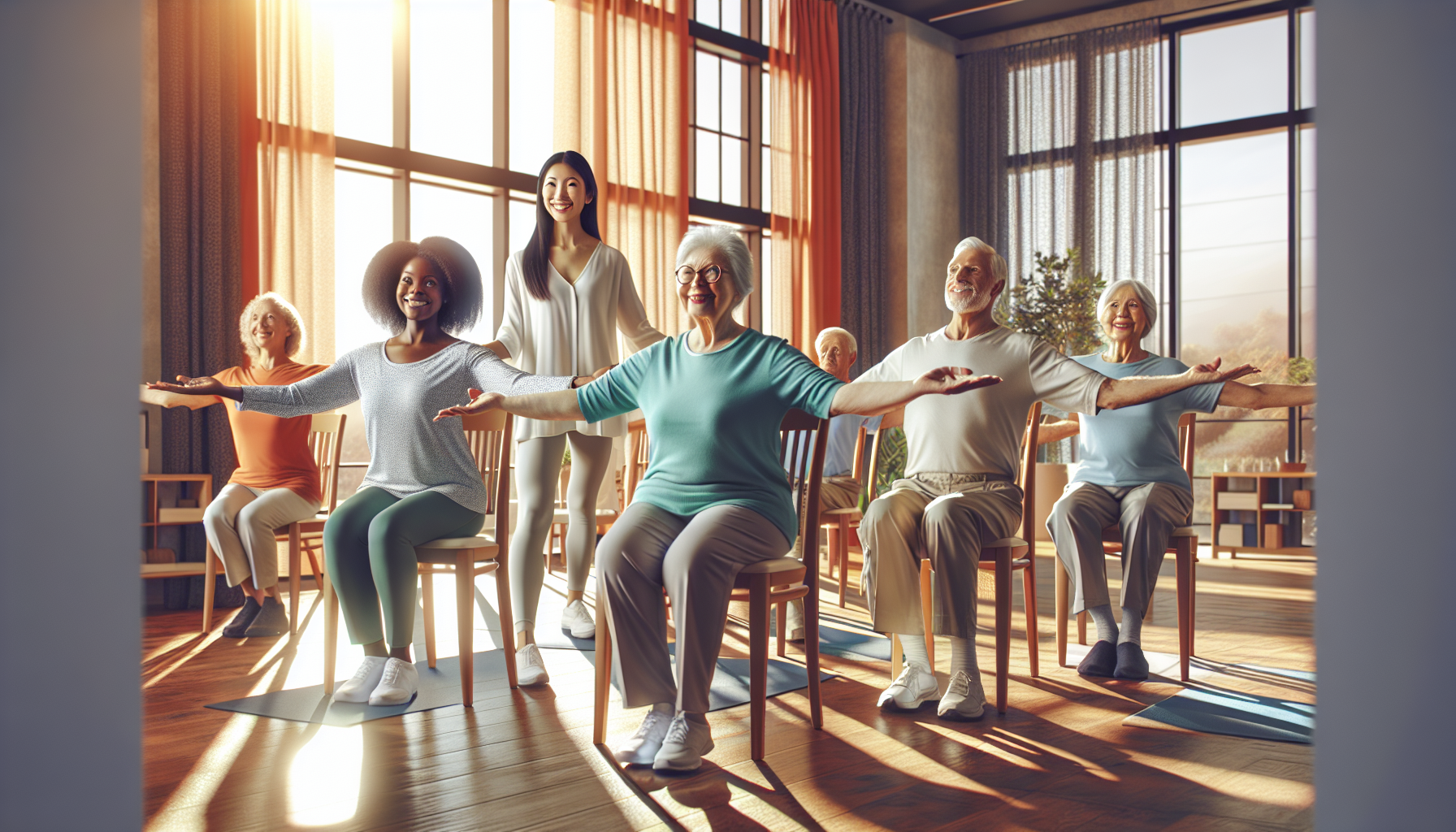
Chair yoga modifies traditional yoga poses so they can be performed while seated in a standard chair or with a chair for balance support. It’s appropriate for seniors with limited mobility, joint pain, or balance concerns that make floor-based or standing yoga difficult. It provides the flexibility, breathing, and mindfulness benefits of yoga without requiring floor transitions.
Unlike the chair exercises article on this site (which focuses on strength), this practice focuses on flexibility, range of motion, stress reduction, and mind-body awareness.
What You Need
A sturdy chair without wheels. Armless chairs or chairs with wide armrests both work. Sit on the front half of the seat so your back isn’t resting against the chair back during most poses — this allows freer spinal movement. Wear loose, comfortable clothing.
The 10 Poses
Hold each pose for 3 to 5 slow breaths unless a specific time is noted. Breathe in through the nose, out through the nose or mouth. Never hold your breath.
1. Seated Mountain Pose (Tadasana)
The foundation. Sit tall at the edge of your chair. Feet flat on the floor, hip-width apart. Spine tall, crown of head lifting toward the ceiling. Shoulders relaxed, away from ears. Hands resting on thighs. Hold for 5 breaths, focusing on your posture. This is the alignment reference point for all other poses.
2. Seated Cat-Cow
Hands on knees. Inhale and gently arch your back, lifting chest and tailbone (cow). Exhale and round your spine, drawing navel toward spine (cat). Repeat 8 to 10 cycles slowly. Lubricates the spine and warms up the core muscles. One of the best morning poses for people with lower back stiffness.
3. Seated Forward Fold
From mountain pose, inhale to sit tall. Exhale and slowly hinge forward from the hips, letting your hands slide down your shins or reach toward your feet. Let the head hang. Hold 5 breaths. Inhale to return upright. Stretches the hamstrings and lower back — areas that tighten significantly from prolonged sitting.
4. Seated Side Bend
Inhale and raise your right arm overhead. Exhale and bend to the left, reaching your right arm to the left as your left hand slides down the chair leg for support. Hold 5 breaths, return, switch sides. Stretches the lateral trunk muscles and the intercostal muscles between the ribs — important for breathing capacity.
5. Seated Spinal Twist
Sit tall. Inhale. Exhale and rotate your upper body to the right. Place your left hand on your right knee and your right hand on the chair back or armrest for support. Hold 5 breaths. Inhale to return to center. Switch sides. Maintains spinal rotation that decreases with age and reduces stiffness in the mid and upper back.
6. Seated Eagle Arms
Extend both arms forward at shoulder height. Cross the right arm under the left at the elbow. If possible, wrap the forearms and bring palms together (or backs of hands together). Lift elbows to shoulder height. Hold 5 breaths. Switch crossing. Opens the upper back and stretches the rear shoulder muscles — important for people with rounded shoulders from desk work or prolonged sitting.
7. Seated Pigeon
Cross your right ankle over your left knee, forming a figure-4. If this is too intense, simply rest the right ankle on the left knee. Sit tall or hinge slightly forward. Hold 5 to 8 breaths. Switch sides. Stretches the outer hip and glutes — areas where tension accumulates during prolonged sitting and contributes to lower back pain.
8. Seated Warrior I Arms
Sit tall. Inhale and raise both arms overhead, palms facing each other. Draw shoulders down away from ears. Hold 5 breaths. This improves shoulder mobility and reinforces upright posture alignment. Progress by adding a slight back bend (lifting the chest and gazing upward) if the neck is comfortable.
9. Neck Rolls
Sit tall, shoulders relaxed. Slowly drop your right ear toward your right shoulder. Roll your chin slowly toward your chest, then toward the left shoulder, and back to center. Complete 3 slow rolls each direction. Releases the neck and upper trapezius — primary tension accumulation sites for most adults.
10. Seated Savasana (Seated Rest)
Rest your back against the chair back. Let your arms fall to your sides, hands resting on your thighs, palms up. Close your eyes. Release all effort from your muscles. Breathe slowly for 3 to 5 minutes. The closing rest is important — it allows the nervous system to integrate the preceding poses. Don’t skip it to save time.
Complete Practice Session
Move through all 10 poses in sequence for a 20 to 25-minute session. Practice 3 to 5 times per week for the best results. Daily practice produces the most consistent flexibility improvement — even 15 minutes daily is more effective than one long session per week.
Free tools to put this into practice
Build a full program around your goal, or plan the gear to support it — both are free and need no sign-up.
AI Workout Plan Builder
Home Gym Equipment Advisor
See all tools →

Written by
Simple Home Workout Editorial Team
Articles are written and edited by the Simple Home Workout editorial team. Content is researched using established exercise and fitness guidance and edited for clarity, practicality, and home-workout use. This is general educational information, not personalized medical, dietetic, or fitness advice.
View all posts →