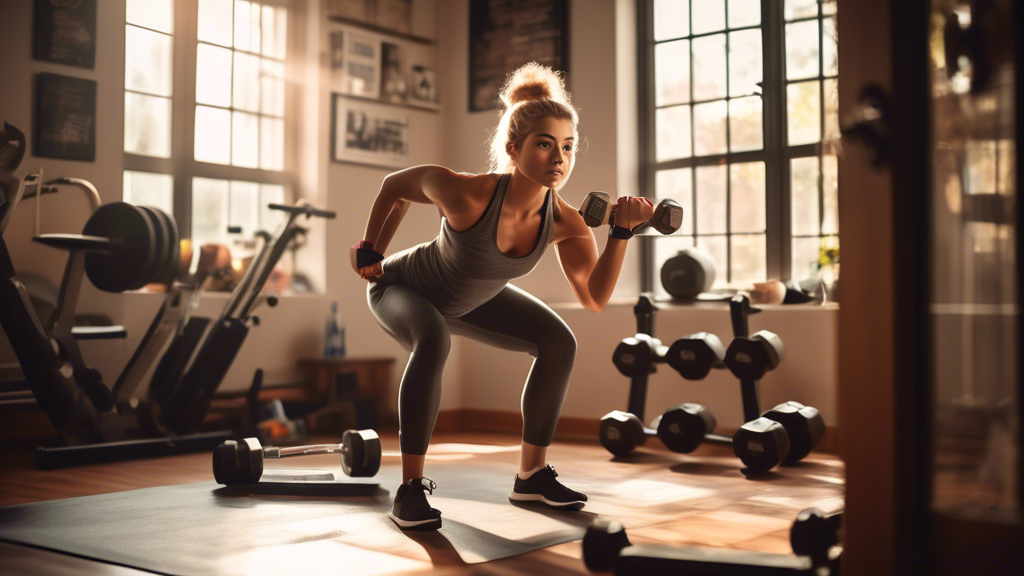
You don’t need a fully equipped gym to build arm muscle at home. A pair of adjustable dumbbells and a resistance band can produce significant arm development — and if you don’t have dumbbells yet, household objects (filled water bottles, a loaded backpack, a gallon jug) work as entry-level substitutes while you build the habit. Here’s exactly how to train arms with whatever you have at home.
What You Need
This guide covers three equipment levels so you can start where you are:
- Level 1: No equipment — bodyweight only (push-ups, dips, floor exercises)
- Level 2: Light improvised weights — water bottles (2–8 lbs), a loaded backpack (10–30 lbs), or a gallon jug (8 lbs)
- Level 3: Resistance bands or adjustable dumbbells — the most effective home arm training setup
If you’re considering buying equipment, our Home Gym Equipment Advisor can recommend adjustable dumbbells or bands within your budget.
Bicep Exercises at Home with Weights
1. Dumbbell / Improvised Bicep Curl
Stand with feet hip-width. Hold weights with palms facing up. Curl hands toward shoulders, keeping elbows pinned at your sides. Lower in 3 seconds.
Coaching cue: Elbows stay fixed — they don’t swing forward or flare out. If they drift, the weight is too heavy. Use lighter objects with perfect form over heavy objects with swing.
Sets and reps: 3 sets of 10–15. Rest 45 seconds between sets.
Progression: Water bottles → gallon jugs → resistance band → adjustable dumbbells starting at 10–15 lbs, progressing 2.5–5 lbs per month.
2. Hammer Curl
Same starting position, but palms face each other (neutral grip) throughout the movement. Curl hands toward shoulders without rotating the wrist.
Coaching cue: The hammer curl targets the brachialis — the muscle that sits underneath your bicep. Developing the brachialis pushes the bicep up, making arms look larger from the front even before the bicep itself grows significantly. Don’t skip this variation.
Sets and reps: 3 sets of 12. Alternate arms (left, right, left, right) to extend time under tension.
3. Concentration Curl
Sit on the edge of a chair. Brace the back of your upper arm against your inner thigh. Curl the weight toward your shoulder. Lower slowly.
Coaching cue: This variation eliminates momentum entirely — your leg acts as a stabiliser that prevents elbow swing. It’s the best isolation curl you can do at home. The range of motion ends when the weight reaches your chin, not your shoulder (longer range = more muscle activation).
Sets and reps: 3 sets of 10–12 each arm.
Tricep Exercises at Home with Weights
4. Dumbbell / Improvised Overhead Tricep Extension
Hold one weight with both hands above your head, elbows pointing up. Lower the weight behind your head by bending your elbows to 90°. Press back up.
Coaching cue: The overhead position is what makes this exercise effective — it puts the tricep long head (the biggest of the three tricep heads) in its fully stretched position, which produces the greatest growth stimulus. Keep elbows pointing straight up throughout; don’t let them drift to the sides.
Sets and reps: 3 sets of 12. Use the heaviest single improvised weight you can manage with control.
5. Dumbbell Skull Crusher (Floor)
Lie on your back on the floor. Hold weights directly above your chest, arms straight. Keeping upper arms vertical, bend elbows and lower weights toward your forehead. Extend back to start.
Coaching cue: Upper arms should not move — only forearms. The moment upper arms start to drift toward your feet, you’re doing a pullover, not a skull crusher. Keep them perpendicular to the floor throughout.
Sets and reps: 3 sets of 10.
6. Tricep Kickback
Hinge at hips to 45°, back flat. Hold weights at your sides with elbows bent. Keeping upper arms parallel to the floor and pinned at your sides, extend forearms behind you until arms are straight. Return slowly.
Coaching cue: The upper arm stays locked parallel to the floor throughout — only the forearm moves. Letting the elbow drop reduces tricep engagement. If you can’t maintain the position, the weight is too heavy.
Sets and reps: 3 sets of 15. A lighter weight with perfect form beats a heavy weight with a moving upper arm.
Sample At-Home Arm Day with Weights
| Exercise | Sets | Reps | Target |
|---|---|---|---|
| Bicep Curl | 3 | 12 | Biceps |
| Overhead Tricep Extension | 3 | 12 | Tricep Long Head |
| Hammer Curl | 3 | 12 | Brachialis + Biceps |
| Floor Skull Crusher | 3 | 10 | Tricep Medial + Lateral Head |
| Concentration Curl | 3 | 10 each | Bicep Isolation |
| Tricep Kickback | 3 | 15 | Tricep Lateral Head |
Rest 45–60 seconds between sets. Train arms 2x per week — muscles need 48 hours between sessions to recover and grow.
Progressive Overload: How to Keep Getting Stronger
Progressive overload is the fundamental principle behind all muscle building — you must give your muscles a progressively harder stimulus over time. At home, without a full dumbbell rack, this means:
- Add reps first: When you can complete 15 clean reps, it’s time to increase load
- Then add load: Move from water bottles to a loaded backpack, then to a resistance band, then to actual dumbbells
- Or increase time under tension: Slow the lowering phase to 4–5 seconds — this increases the challenge without needing more weight
- Or increase sets: Move from 3 to 4 sets per exercise before adding load
Common Mistakes
- Using objects that are too light: If the last 2 reps don’t feel challenging, the load needs to increase. “I felt fine” usually means the muscles weren’t sufficiently challenged.
- Training biceps only: Triceps are two-thirds of upper arm mass. A balanced arm routine trains both equally — not 4 bicep exercises and 1 tricep exercise.
- Not tracking progress: Keep a simple log (date, exercise, reps, load). Without tracking, you’ll likely repeat the same session for months without progression.
For a fully personalized home arm training plan, try our AI Workout Plan Builder. If a specific exercise isn’t working for you, our Exercise Substitute Finder has instant alternatives.
References
- Schoenfeld BJ. “The mechanisms of muscle hypertrophy and their application to resistance training.” Journal of Strength and Conditioning Research, 24(10): 2857–2872, 2010.
- American Council on Exercise. ACE Personal Trainer Manual, 5th ed. ACE, 2014.
Free tools to put this into practice
Build a full program around your goal, or plan the gear to support it — both are free and need no sign-up.
AI Workout Plan Builder
Home Gym Equipment Advisor
See all tools →

Written by
Simple Home Workout Editorial Team
Articles are written and edited by the Simple Home Workout editorial team. Content is researched using established exercise and fitness guidance and edited for clarity, practicality, and home-workout use. This is general educational information, not personalized medical, dietetic, or fitness advice.
View all posts →