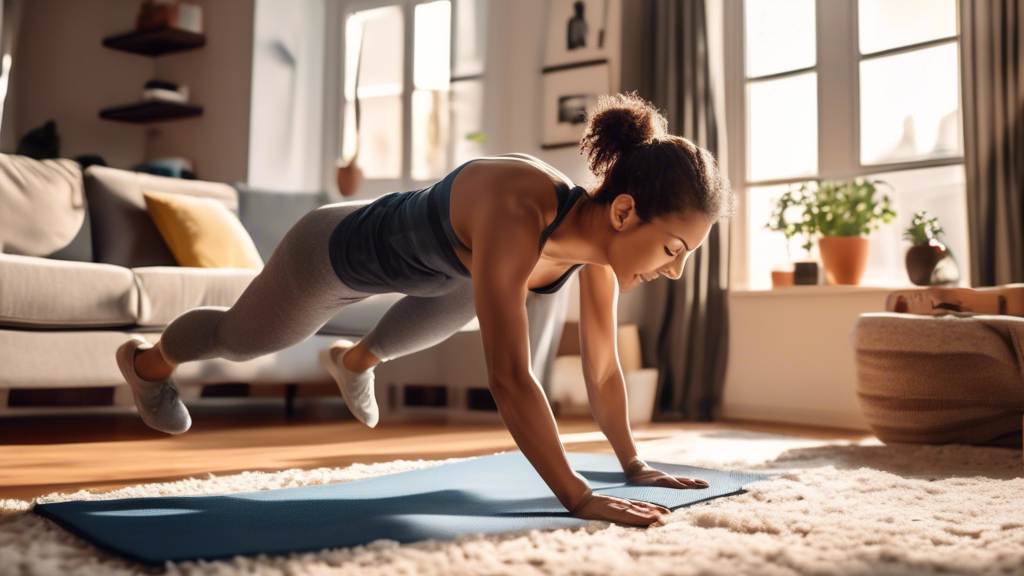
Not all bodyweight exercises fit in small spaces equally. A forward lunge travels more floor space than a reverse lunge. A burpee requires you to go from standing to fully prone and back. Side shuffles need lateral room many rooms don’t have.
This guide ranks exercises by floor footprint and training value so you can build a workout that fits where you actually are.
Zero Extra Footprint — Stand in Place
Bodyweight squat
Footprint: Your standing position
Effectiveness: Very high — quads, hamstrings, glutes, core
One of the best small-space exercises. Scales from beginner (standard squat) to advanced (single-leg squat, jump squat) without moving an inch.
Standing hip hinge
Footprint: Your standing position
Effectiveness: High — hamstrings, glutes, lower back
Essential posterior chain work. Push hips back while keeping back flat, stand back up. Often skipped in home workouts, which leads to quad-dominant imbalances.
Calf raise
Footprint: Your standing position
Effectiveness: Moderate — calves, ankle stability
Hold a wall for balance. Single-leg version doubles the demand.
High knee march
Footprint: Your standing position
Effectiveness: Moderate — hip flexors, low-impact cardiovascular
The best cardio option for very small spaces and apartment situations. No lateral movement, no impact.
Small Footprint — Body Length Only
Push-up
Footprint: Body length, lying down
Effectiveness: Very high — chest, triceps, shoulders, core
The most versatile small-space exercise. Wide-grip, close-grip, pike, decline, explosive — dozens of variations on the same mat.
Plank
Footprint: Body length
Effectiveness: High — deep core, shoulders, stability
Progression happens through time, instability, and movement (shoulder taps, leg lifts) without needing more space.
Glute bridge
Footprint: Body length
Effectiveness: High — glutes, hamstrings, lower back
One of the most underrated small-space exercises. Single-leg version is genuinely difficult.
Superman hold
Footprint: Body length, lying face down
Effectiveness: Moderate — spinal extensors, glutes, rear shoulders
Important for balance — most small-space workouts are front-dominant. This counters that.
Reverse lunge
Footprint: One step backward
Effectiveness: High — quads, glutes, hamstrings, balance
Requires only a step back instead of forward, making it more space-efficient than a standard lunge. Equally effective.
Medium Footprint — Full Mat Required
Mountain climber
Footprint: Body length, low lateral spread
Effectiveness: High — core, hip flexors, cardiovascular
Entirely mat-based. Good cardio without lateral movement or jumping. Can be done quietly.
Burpee (modified)
Footprint: Body length plus 2 to 3 feet
Effectiveness: Very high — full-body strength and conditioning
Can be adapted for small spaces by stepping out and in rather than jumping. Reduces both footprint and noise significantly.
Inchworm
Footprint: Body length with some forward travel
Effectiveness: Moderate — hamstrings, core, shoulder stability, warm-up
Best used as warm-up. Can minimize travel by walking hands back rather than stepping forward.
What to Avoid in Small Spaces
Forward lunges (travel forward), jumping jacks (lateral spread), side shuffles (lateral travel), and standard burpees with jumps all require more room than most apartments provide. Replace them with their small-space equivalents above.
Sample 25-Minute Small-Space Circuit
Three to four rounds, 60 seconds rest between rounds:
- Bodyweight squat: 15 reps
- Push-up: 12 reps
- Glute bridge: 15 reps
- High knee march: 45 seconds
- Reverse lunge: 10 per side
- Plank hold: 30 seconds
Free tools to put this into practice
Build a full program around your goal, or plan the gear to support it — both are free and need no sign-up.
AI Workout Plan Builder
Home Gym Equipment Advisor
See all tools →

Written by
Simple Home Workout Editorial Team
Articles are written and edited by the Simple Home Workout editorial team. Content is researched using established exercise and fitness guidance and edited for clarity, practicality, and home-workout use. This is general educational information, not personalized medical, dietetic, or fitness advice.
View all posts →