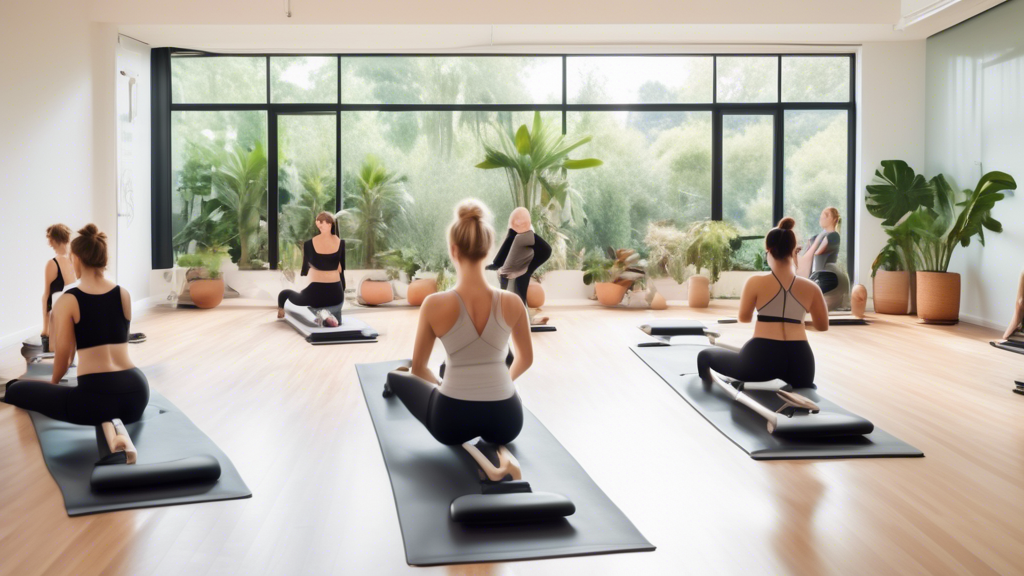
Most ab workouts — crunches, sit-ups, leg raises — train the rectus abdominis, the outermost abdominal muscle. This is the muscle visible as a “six pack.” Pilates targets something different: the transverse abdominis (the deep inner abs), the multifidus (deep spinal stabilizers), and the pelvic floor. These muscles stabilize the spine before movement happens — they’re why a strong core actually prevents back pain and improves athletic performance.
This article explains what those muscles do, why they matter, and gives you five exercises that specifically target them, with the form cues that make the difference between going through the motions and actually training the right muscles.
The Core Muscles Most Workouts Miss
Transverse abdominis (TVA)
The deepest abdominal layer. Wraps around your torso like a corset. Activates before any limb movement to brace the spine — it fires in anticipation of load, not in reaction to it. When it’s weak, larger muscles compensate, creating a less stable, more injury-prone pattern.
Multifidus
Small muscles running alongside each vertebra. Provide intersegmental stability — they control how individual vertebrae move relative to each other. People with chronic lower back pain consistently show reduced multifidus size and activation on the affected side. Pilates and bird-dog exercises are the primary tools rehabilitation specialists use to retrain them.
Pelvic floor
The base of the core. Works with the TVA, multifidus, and diaphragm to maintain intra-abdominal pressure. Affects bladder control, hip stability, and core force transfer.
What Pilates Does Differently
Pilates exercises require you to maintain a stable spine and pelvis while moving your limbs. This forces the deep stabilizers to work continuously — not just at the peak of a movement. Add breath control (exhale on exertion, inhale to prepare) and you’re also coordinating the diaphragm with the rest of the system. It’s more neurologically demanding than a crunch, which is why people who’ve done years of ab work often find Pilates unexpectedly difficult.
5 Exercises That Target Deep Core Muscles
1. Dead Bug
Primary muscles: transverse abdominis, multifidus
Lie on your back. Arms toward ceiling, knees at 90 degrees above hips (tabletop). Press your lower back firmly into the mat — this is critical and must be maintained throughout. Exhale and slowly extend your right arm overhead while simultaneously extending your left leg. Keep the back pressed down. Return and switch sides.
Why it targets deep core: Maintaining a stable spine while extending opposite limbs is exactly the anti-extension, anti-rotation demand that forces TVA and multifidus activation.
Reps: 3 sets of 8 per side
2. Heel Slide
Primary muscles: transverse abdominis, lower abdominals
Lie on your back, knees bent, feet flat, lower back pressing gently into the mat. Exhale and slowly slide one heel along the floor, fully straightening that leg, while keeping the lower back from arching. Slide it back. Alternate sides.
Why it targets deep core: One of the most direct TVA exercises available. The slow limb movement while holding a pressed lower back isolates the deep core with minimal rectus abdominis involvement.
Reps: 3 sets of 10 per side
3. The Hundred
Primary muscles: TVA, hip flexors, breathing coordination
Lie on your back. Curl head and shoulders up. Extend legs to 45 degrees (raise them higher if your back arches). Arms reach long at hip height, pump up and down vigorously. Inhale 5 pumps, exhale 5 pumps. 10 breath cycles equals 100 pumps.
Why it targets deep core: The combination of limb extension load and forced breathing pattern coordinates the full deep core system in a way static exercises don’t.
Reps: Start with 30 pumps, build to full 100
4. Single-Leg Circle
Primary muscles: TVA, hip stabilizers
Lie on your back. Extend one leg toward the ceiling. Draw small circles with the extended leg — crossing center, down, around, and back up. Keep the pelvis completely still. 5 circles each direction per leg.
Why it targets deep core: Any weakness in the deep stabilizers shows immediately as a rocking or shifting pelvis. The exercise gives you real-time feedback on your stability.
Reps: 3 sets of 5 circles each direction per leg
5. Bird Dog
Primary muscles: multifidus, TVA, glutes
On all fours. Hands under shoulders, knees under hips, spine neutral. Extend your right arm forward and left leg back simultaneously. Hold 3 seconds. Return with control, switch sides. Keep hips level — no rotation.
Why it targets deep core: The anti-rotation demand specifically activates the multifidus. This is why it appears in nearly every physical therapy protocol for lower back rehabilitation.
Reps: 3 sets of 10 per side
Adding These to Your Routine
These five exercises work well as a 15-minute standalone routine or as a core finisher after any other workout. Do them 2 to 3 times per week. Unlike high-intensity ab circuits, they don’t require significant recovery time — the deep stabilizers respond well to frequent, controlled practice at moderate effort.
Free tools to put this into practice
Build a full program around your goal, or plan the gear to support it — both are free and need no sign-up.
AI Workout Plan Builder
Home Gym Equipment Advisor
See all tools →

Written by
Simple Home Workout Editorial Team
Articles are written and edited by the Simple Home Workout editorial team. Content is researched using established exercise and fitness guidance and edited for clarity, practicality, and home-workout use. This is general educational information, not personalized medical, dietetic, or fitness advice.
View all posts →