The standard advice for staying fit as a stay-at-home parent — “wake up an hour early” or “work out during naptime” — ignores that naps are unpredictable, early mornings are already brutal, and most workouts assume you have 45 uninterrupted minutes. Here’s what actually works.
The Core Problem: Fitness Advice Assumes You Have Time Blocks
Most workout programs are designed for people who can block out 30–60 minutes reliably. Stay-at-home parents often can’t. The solution isn’t a different program — it’s a different structure: workouts designed to be completed in segments, resumed after interruption, or done with a kid in the room.
Strategy 1: The 10-Minute Micro-Workout
Three 10-minute sessions spread through the day is just as effective as one 30-minute session, according to exercise physiology research. The key is making each session count.
A complete 10-minute routine:
- Push-ups: 3 sets of as many as possible (AMRAP) with 30 seconds rest
- Bodyweight squats: 3 × 15
- Plank: 2 × 30 seconds
Do this once in the morning, once midday, once in the evening. That’s 30 minutes of training without needing a continuous block.
Strategy 2: Naptime Workouts (When They Happen)
Naptime workouts work best when you have a pre-loaded routine that starts immediately — no deciding what to do, no warming up for 10 minutes. Have one go-to workout ready:
The 20-Minute Naptime Circuit (3 rounds):
- Jump squats × 10 (or bodyweight squats if noise is a concern)
- Push-up to downward dog × 8
- Reverse lunges × 10 per leg
- Mountain climbers × 20
- Superman hold × 5 (hold 3 seconds each)
Rest 60 seconds between rounds. Total time: ~20 minutes.
Strategy 3: Workout With Your Kids
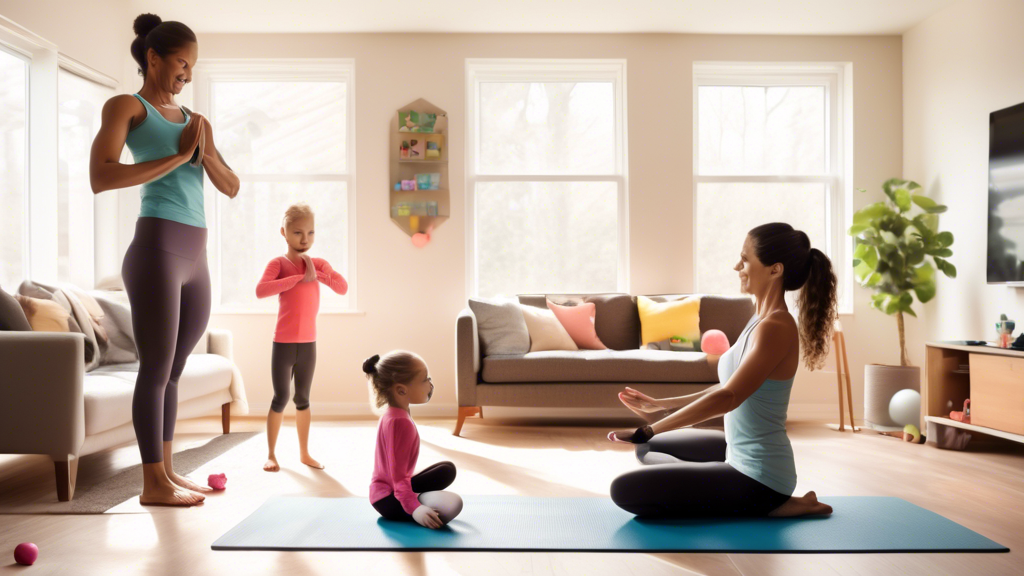
This works better than most parents expect. Kids 2 and up can follow simple movement games. Make the workout a game:
- Follow the leader: You do squats, they do squats. You do bear crawls, they do bear crawls.
- Obstacle course: Set up pillows and furniture. Crawl over, jump around, balance on one foot. You’re doing it too.
- Resistance with a toddler: Hold your kid on your chest during squats (baby squat). Push them in a stroller for interval walking. Let them sit on your back for a “mommy/daddy push-up.”
These aren’t full workouts by themselves, but they add meaningful movement on days when nothing else is possible.
The Minimal Equipment Setup That Fits Any Space
For stay-at-home parents, bulky home gym equipment usually becomes a storage problem. The most useful items by size-to-value ratio:
- Resistance band set (~$15–25): Dozens of exercises, stores in a drawer
- Doorframe pull-up bar (~$25): Rows, chin-ups, hanging core work
- Yoga mat (~$20): Comfortable floor work
That’s ~$60 and fits in a small closet.
Building a Realistic Weekly Schedule
Stop trying to follow a standard 5-day program. Instead, commit to a minimum: 3 days per week, at least 20 minutes each. Everything beyond that is a bonus.
- Monday: Upper body (push-ups, band rows, band curls) — 20–25 min
- Wednesday: Lower body (squats, lunges, glute bridges) — 20–25 min
- Friday: Core + cardio (plank variations, mountain climbers, jump squats) — 20 min
This is sustainable. A 5-day program you abandon after two weeks accomplishes nothing. Three consistent days accomplishes a lot.
On Consistency vs. Perfection
Some weeks you’ll get all three sessions. Some weeks you’ll get one. Both are fine. The parents who maintain fitness long-term aren’t the ones who never miss a session — they’re the ones who return quickly after missing one. Lower the bar enough that you can always clear it.
Free tools to put this into practice
Build a full program around your goal, or plan the gear to support it — both are free and need no sign-up.
AI Workout Plan Builder
Home Gym Equipment Advisor
See all tools →

Written by
Simple Home Workout Editorial Team
Articles are written and edited by the Simple Home Workout editorial team. Content is researched using established exercise and fitness guidance and edited for clarity, practicality, and home-workout use. This is general educational information, not personalized medical, dietetic, or fitness advice.
View all posts →