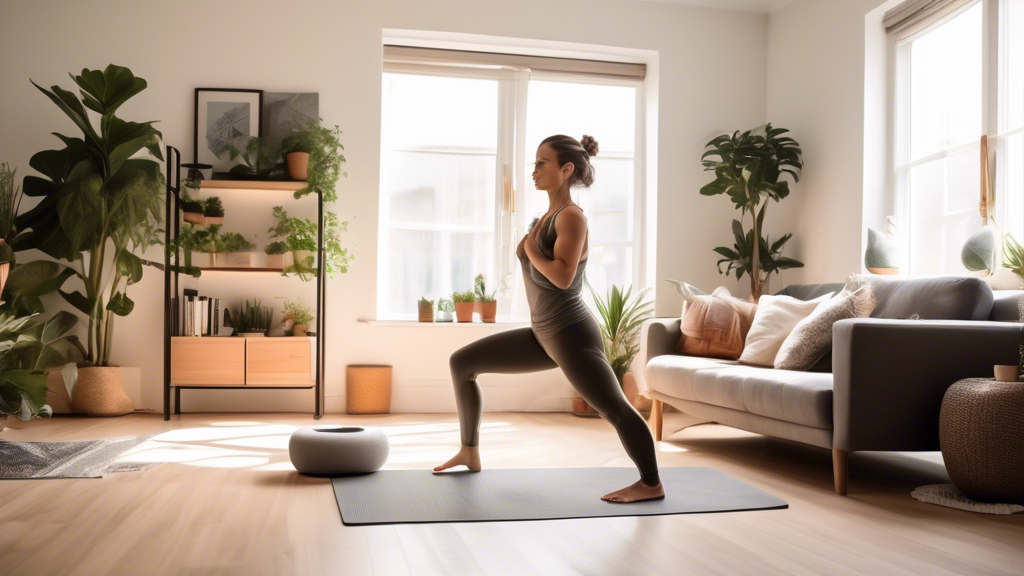
You don’t need much space to start working out — a 4×6 foot area and 20 minutes is enough for a complete beginner session. This routine covers all major muscle groups using only bodyweight movements that fit within that footprint. If you’re new to exercise or returning after a long break, start here.
Before You Start
Three things to check:
- Clear the area of anything you can step on or bump into
- Use a yoga mat or towel if the floor is hard or slippery
- Have water nearby — you’ll need it
The 5-Exercise Circuit
These five exercises cover your legs, push muscles, posterior chain, core, and pulling muscles. They require nothing beyond your bodyweight and a 4×6 foot space.
Exercise 1: Bodyweight Squat
Feet shoulder-width, chest up. Lower until thighs are parallel to the floor (or as deep as comfortable). Drive through heels to return. This is the foundational lower body movement.
Beginner: 3 × 10 reps
If squatting to parallel is uncomfortable: Squat to a chair (sit lightly, stand back up) until mobility improves.
Exercise 2: Knee Push-Up
From a kneeling plank position, lower your chest toward the floor and press back up. Keep your body in a straight line from knees to head — no raised hips, no sagging core.
Beginner: 3 × 8 reps
Progress to: Full push-up when you can complete 3 × 10 knee push-ups with perfect form.
Exercise 3: Glute Bridge
Lie on your back, feet flat and hip-width, knees bent. Drive hips upward, hold 2 seconds at the top, lower. Trains your glutes, hamstrings, and lower back stabilizers.
Beginner: 3 × 12 reps
Exercise 4: Standing Calf Raise
Hold a wall or chair for balance. Rise onto toes as high as possible, hold 1 second, lower fully. Full range matters more than speed.
Beginner: 3 × 15 reps
Exercise 5: Dead Bug
Lie on your back, arms pointing to ceiling, knees bent at 90°. Slowly lower one arm overhead and the opposite leg toward the floor while pressing your lower back flat. Return and switch sides. Trains deep core stability.
Beginner: 3 × 6 per side
The 20-Minute Session Plan
- Warm-up (3 min): March in place → arm circles → hip circles → 5 slow squats
- Circuit (15 min): Complete all 5 exercises back-to-back. Rest 20 sec between exercises, 75 sec between rounds. Do 3 rounds.
- Cool-down (2 min): Standing quad stretch → seated hamstring stretch → deep breathing
Common Beginner Mistakes
- Going too fast. Slow, controlled reps build more strength and are safer than rushing. If you’re bouncing through squats, slow down.
- Skipping the cool-down. 2 minutes of stretching significantly reduces next-day soreness, especially in the first few weeks.
- Stopping when sore. Mild soreness 24–48 hours after your first sessions is normal. Train through it (at lower intensity if needed) rather than waiting until you feel 100%.
Frequency and Progress
Start with 3 sessions per week with at least one day between each. After 2 weeks, progress by: adding 1–2 reps per exercise, or reducing rest between exercises to 15 sec, or moving to harder variations (full push-up, single-leg glute bridge). After 4–6 weeks of this routine, you’ll be ready for a more demanding beginner program.
Free tools to put this into practice
Build a full program around your goal, or plan the gear to support it — both are free and need no sign-up.
AI Workout Plan Builder
Home Gym Equipment Advisor
See all tools →

Written by
Simple Home Workout Editorial Team
Articles are written and edited by the Simple Home Workout editorial team. Content is researched using established exercise and fitness guidance and edited for clarity, practicality, and home-workout use. This is general educational information, not personalized medical, dietetic, or fitness advice.
View all posts →