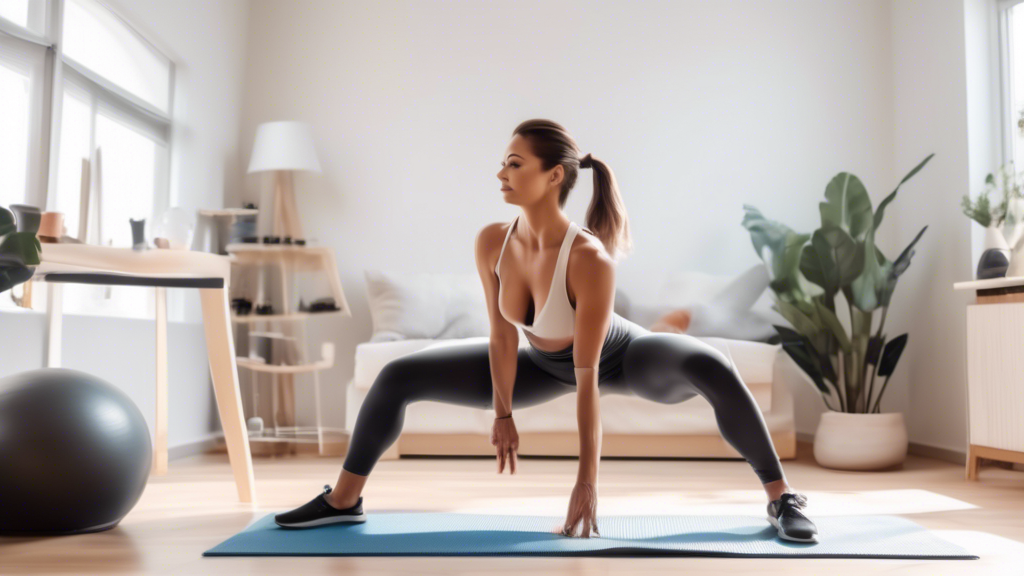
The biggest mistake in bodyweight leg training is doing the same exercises at the same difficulty indefinitely. Your legs adapt quickly — within 4–6 weeks — and then stop responding. The solution isn’t doing more reps of the same exercises. It’s moving to harder variations.
This guide gives you 10 exercises, each with a beginner and advanced version, so you always have a harder challenge waiting when the current one gets easy.
Why Bodyweight Can Build Real Leg and Glute Strength
A pistol squat (single-leg squat to full depth) requires roughly 1.5–2× your bodyweight of force through your quad. A Bulgarian split squat creates similar loading. The limiting factor in home training isn’t the lack of a barbell — it’s the lack of a plan to make the exercises progressively harder.
Exercise 1: Squat
Beginner: Bodyweight squat — feet shoulder-width, chest up, thighs parallel to floor at the bottom. 3 × 15.
Advanced: Pistol squat — single-leg squat to full depth, extending the non-working leg in front. Use a doorframe for balance until you have the strength to go unsupported. 3 × 5 per leg.
Bridge variation: Pause squat (3-sec hold at bottom) when the basic squat is easy but the pistol isn’t yet accessible. 3 × 10.
Exercise 2: Lunge
Beginner: Reverse lunge — step back to reduce knee stress on the front leg. 3 × 10 per leg.
Advanced: Bulgarian split squat — rear foot elevated on a chair, deep range of motion. 3 × 8 per leg. This is the most effective single-leg exercise in bodyweight training.
Bridge variation: Walking lunge across a room and back. 3 sets.
Exercise 3: Hip Hinge
Beginner: Glute bridge — on your back, drive hips up, 2-second hold. 3 × 15.
Advanced: Nordic hamstring curl — feet hooked under sofa, kneel upright, lower body slowly using hamstrings only, catch with hands. 3 × 5 negatives. No other bodyweight exercise builds hamstring strength comparably.
Bridge variation: Single-leg Romanian deadlift with bodyweight. 3 × 8 per leg.
Exercise 4: Hip Thrust
Beginner: Single-leg glute bridge on the floor. 3 × 12 per leg.
Advanced: Hip thrust with shoulders on a couch — longer range of motion, heavier loading. Add a resistance band across your hips for extra resistance. 3 × 12.
Exercise 5: Step-Up
Beginner: Step-up on a low, sturdy surface (bottom stair, thick book stack). Step with one foot, bring the other up, step back down. 3 × 10 per leg.
Advanced: Elevated step-up (higher surface, like a chair) — a greater range of hip and knee flexion creates far more demand on the quads and glutes. 3 × 8 per leg.
Exercise 6: Lateral Lunge
Beginner: Lateral lunge — step to one side, sit into that leg while the other stays straight. 3 × 8 per leg.
Advanced: Cossack squat — a deeper, more flexible lateral lunge with the heel of the straight leg raised. 3 × 6 per leg. Trains the inner thigh and hip mobility simultaneously.
Exercise 7: Fire Hydrant
Beginner: On all fours, lift one knee out to the side (like a dog at a fire hydrant). 3 × 15 per side.
Advanced: Fire hydrant with leg extension — after lifting the knee out, extend the leg fully behind you. 3 × 12 per side. Adds glute medius and minimus activation to the movement.
Exercise 8: Calf Raise
Beginner: Two-leg standing calf raise — rise onto toes, hold 1 second, lower fully. 3 × 20.
Advanced: Single-leg calf raise — one leg at a time, full range of motion. Add tempo (3 seconds up, 3 seconds down) for extra difficulty. 3 × 15 per leg.
Exercise 9: Glute Kickback
Beginner: On all fours, kick one leg back and up, squeezing the glute at the top. 3 × 15 per leg.
Advanced: Donkey kick with a resistance band around your ankles for added resistance. 3 × 12 per leg.
Exercise 10: Explosive Jump Squat
Beginner: Squat jump — squat down and explode upward into a jump, landing softly with knees bent. 3 × 8.
Advanced: Broad jump — jump forward as far as possible, landing in a controlled squat. 3 × 5. Develops lower body power and fast-twitch muscle fiber recruitment.
Sample Weekly Schedule
You can train legs and glutes 3 times per week. Alternate between these two sessions:
Session A: Squat + Lunge + Hip thrust + Calf raise + Explosive jump
Session B: Hip hinge + Step-up + Lateral lunge + Fire hydrant + Glute kickback
Example week: Session A Monday, Session B Wednesday, Session A Friday. Next week, flip: Session B Monday, Session A Wednesday, Session B Friday.
When to Progress
Move to the advanced version of an exercise when you can complete all prescribed reps with:
- Full range of motion
- Controlled tempo (no collapsing down quickly)
- No compensations (knee caving, torso leaning heavily to one side)
- Energy remaining at the end of the last set
This might take 2 weeks or 6 weeks for any given exercise. Progress at the rate your body allows, not at a preset calendar schedule.
Free tools to put this into practice
Build a full program around your goal, or plan the gear to support it — both are free and need no sign-up.
AI Workout Plan Builder
Home Gym Equipment Advisor
See all tools →

Written by
Simple Home Workout Editorial Team
Articles are written and edited by the Simple Home Workout editorial team. Content is researched using established exercise and fitness guidance and edited for clarity, practicality, and home-workout use. This is general educational information, not personalized medical, dietetic, or fitness advice.
View all posts →