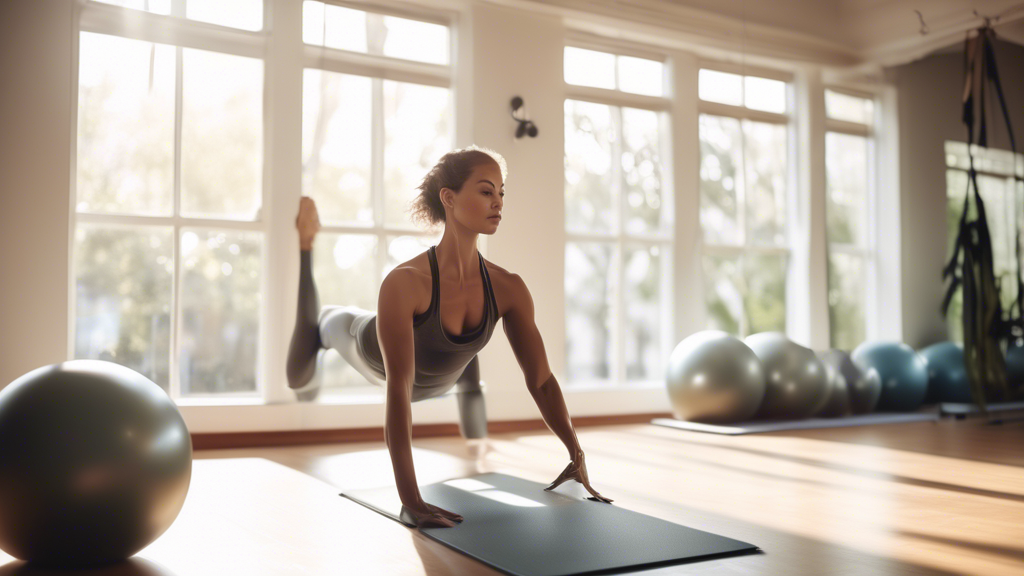
If you’re new to Pilates, the most important thing to know is that the quality of each movement matters more than how many exercises you do. A beginner doing three exercises with full control and correct breathing gets more benefit than someone rushing through ten moves without the fundamentals. This routine gives you five foundational exercises with detailed instructions.
The Fundamentals Before You Start
Finding Neutral Spine
Lie on your back with knees bent. There should be a small space under your lower back — that’s neutral spine. Not pressing flat to the floor (posterior tilt), not arching dramatically (anterior tilt). This is the starting position for most Pilates exercises and the position your spine should maintain throughout.
The Pilates Breath
Breathe in through your nose, expanding your ribcage sideways. Breathe out through your mouth, drawing your navel gently in toward your spine. On the exhale, your deep core activates automatically. Practice this 5 times before starting the exercises.
Exercise 1: Imprinting
Purpose: Teaches pelvic control and activates the deep core
Lie on your back in neutral spine. On the exhale, press your lower back gently into the mat (posterior tilt), then on the inhale return to neutral. Do this 10 times slowly. This activates the transverse abdominis and pelvic floor — the foundation of everything else. Spend 3 minutes here before moving on.
Exercise 2: Pelvic Curl
Purpose: Spinal articulation, glute activation, core sequencing
From neutral spine, exhale and begin to curl your tailbone off the mat, then each vertebra progressively until you’re in a bridge with only your shoulders and head on the mat. Inhale at the top. Exhale to lower vertebra by vertebra back to neutral — tailbone last. Every vertebra should peel off and return separately. 3 × 6 reps.
If any segment of your spine “clumps” instead of rolling, that area needs more mobility work — do the exercise anyway, slowly.
Exercise 3: Leg Slides
Purpose: Core stability with limb movement — the core’s primary real-world function
From neutral spine with both knees bent, exhale and slowly slide one heel away from you along the mat until the leg is nearly straight. Inhale, then exhale to return. Your pelvis must not move at all throughout. This looks trivially easy; with perfect pelvic stability, it is genuinely challenging. 2 × 10 per leg.
Exercise 4: The Hundred (Beginner Version)
Purpose: Core endurance, breath coordination
Lie on your back, knees bent, feet flat. Exhale and curl your head and shoulders off the mat (like a crunch, but hold the position). Arms long by your sides. Pump your arms in small controlled beats — 5 short inhales for 5 pumps, 5 short exhales for 5 pumps. Aim for 50 pumps (5 full breath cycles) to start, building to 100 over weeks. Lower your head if your neck tires.
Exercise 5: Single-Leg Stretch
Purpose: Oblique anti-rotation, coordination, hip flexor endurance
Stay curled up from the Hundred. Pull your right knee toward your chest with both hands while extending your left leg to 45°. Switch legs in a controlled rhythm — left knee in, right leg out. Your torso stays completely still. 3 × 8 alternating reps.
If 45° is too demanding, extend the leg to 60° or higher until core strength builds.
The Complete Beginner Session (20 Minutes)
- Breathing practice — 3 min
- Imprinting — 10 reps, slow
- Pelvic Curl — 3 × 6
- Leg Slides — 2 × 10 per leg
- Hundred (beginner) — 2 sets of 50 pumps
- Single-Leg Stretch — 3 × 8
- Spine Stretch Forward (seated) — 3 × 5
Practice 3 times per week. After 3–4 weeks, the control and breath coordination will feel natural, and you’ll be ready to add the Roll-Up, Leg Circles, and Double-Leg Stretch from the intermediate repertoire.
Free tools to put this into practice
Build a full program around your goal, or plan the gear to support it — both are free and need no sign-up.
AI Workout Plan Builder
Home Gym Equipment Advisor
See all tools →

Written by
Simple Home Workout Editorial Team
Articles are written and edited by the Simple Home Workout editorial team. Content is researched using established exercise and fitness guidance and edited for clarity, practicality, and home-workout use. This is general educational information, not personalized medical, dietetic, or fitness advice.
View all posts →