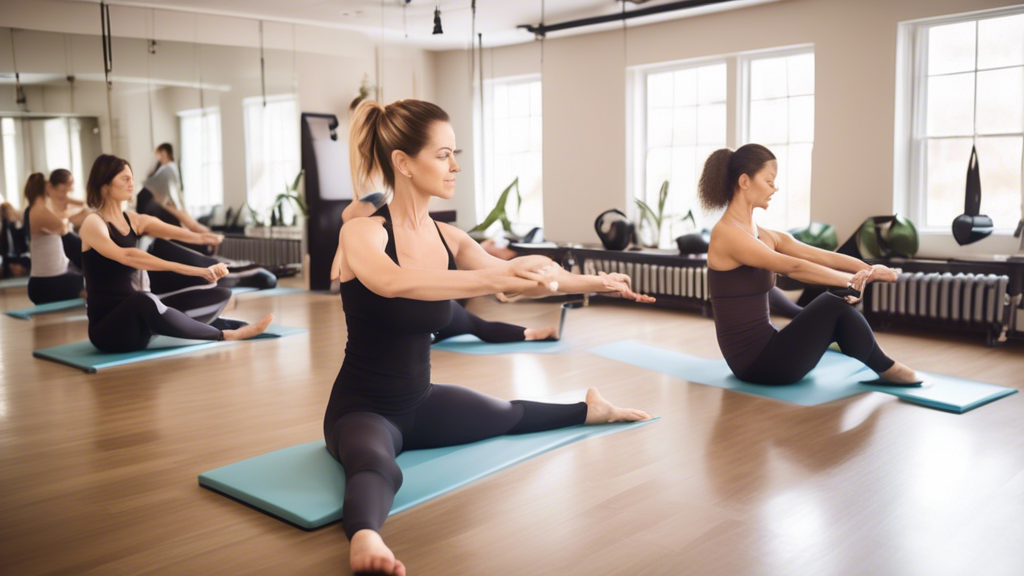
Pilates is one of the most effective approaches to building a strong, stable core — but the exercises look deceptively simple and are often done incorrectly by beginners. This guide breaks down the five most effective Pilates core exercises with precise instructions, common mistakes, and beginner modifications for each.
Before You Start: The Pilates Breath
In Pilates, breathing is technique, not just breathing. The pattern is: inhale to prepare, exhale on the effort. Each exhale should be fully complete — this activates the deep transverse abdominis automatically, which is the primary muscle Pilates targets. Practice this breathing before adding any exercise.
Exercise 1: The Hundred
What it builds: Core endurance, breath coordination, deep abdominal engagement
How to: Lie on your back. Curl head and shoulders off the mat. Arms reach long by your sides. Pump arms in small, controlled beats — 5 beats inhale, 5 beats exhale = 1 breath cycle. Complete 10 breath cycles (100 beats).
Beginner modification: Keep knees bent and feet flat on the mat rather than extending legs.
Common mistake: Lifting with the neck instead of the core. If your neck tires first, place your head on the mat and focus only on the breath and arm pump.
Exercise 2: The Roll-Up
What it builds: Spinal articulation, hamstring flexibility, sequential core control
How to: Lie flat, arms reaching overhead. Inhale, then exhale as you peel your spine off the mat starting from your head — one vertebra at a time — until you’re sitting upright reaching over your legs. Inhale, then exhale to roll back down the same way.
Beginner modification: Bend knees slightly to reduce hamstring demand. Use a towel behind your thighs to assist the roll-up phase.
Common mistake: Using momentum to “throw” yourself up. If you can’t roll up without momentum, your spinal flexibility is limited — the exercise is still worth doing slowly with assistance.
Exercise 3: Single-Leg Stretch
What it builds: Oblique strength, anti-rotation stability, hip flexor endurance
How to: Lie on your back, curl head and shoulders up. Pull your right knee to your chest while your left leg extends to 45°. Switch. Maintain a still torso as the legs alternate — no rocking, no hip rotation. 3 × 10 alternating reps.
Beginner modification: Keep the extended leg higher (60–70° from floor) to reduce demand on the core.
Common mistake: Letting the hips rock side to side as you switch legs. The pelvis should be completely still throughout.
Exercise 4: Leg Circles
What it builds: Deep hip stability, pelvic stability, hip joint mobility
How to: Lie on your back, one leg extended to ceiling, other leg flat on mat. Circle the raised leg across your body, down, out, and back to center — keeping the pelvis completely still. 5 circles each direction. Switch legs. 2 sets.
Beginner modification: Make the circles small — perhaps 6 inches in diameter initially. Increase size only as you can maintain pelvic stability.
Common mistake: Letting the pelvis rock with each circle. The entire point of the exercise is not letting it move.
Exercise 5: Spine Stretch Forward
What it builds: Spinal flexion mobility, posterior chain awareness, seated core stability
How to: Sit upright with legs extended and slightly wider than hip-width. Inhale to lengthen the spine tall. Exhale as you slowly round forward from your head down through each vertebra, reaching hands toward feet. Inhale, then exhale to roll back to upright. 3 × 6.
Beginner modification: Sit on a rolled mat or blanket to tilt your pelvis slightly forward if tight hamstrings make upright sitting difficult.
Common mistake: Bending from the hips (hip flexion) instead of the spine (spinal flexion). The rounding should start from the top of the head and progress downward.
A Complete 20-Minute Beginner Pilates Session
- Breathing practice — 3 min
- Hundred (modified) — 2 sets of 50 pumps
- Roll-Up — 3 × 5
- Single-Leg Stretch — 3 × 10
- Leg Circles — 2 × 5 per direction, per leg
- Spine Stretch Forward — 3 × 6
Practice 3× per week. Progress shows in control and precision rather than difficulty — when you can do all five exercises with full control and no compensations, the exercises produce more results, not less.
Free tools to put this into practice
Build a full program around your goal, or plan the gear to support it — both are free and need no sign-up.
AI Workout Plan Builder
Home Gym Equipment Advisor
See all tools →

Written by
Simple Home Workout Editorial Team
Articles are written and edited by the Simple Home Workout editorial team. Content is researched using established exercise and fitness guidance and edited for clarity, practicality, and home-workout use. This is general educational information, not personalized medical, dietetic, or fitness advice.
View all posts →