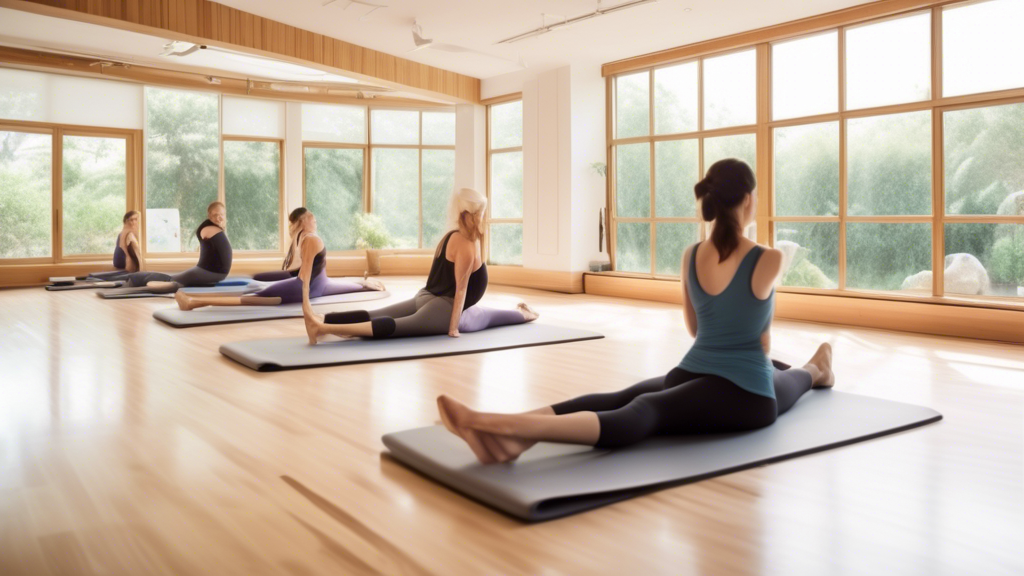
This is a progressive Pilates program structured across three levels. Beginner exercises build the foundation: teaching deep core muscles to activate and the spine to move with control. Intermediate exercises add limb movement and coordination demands. Advanced exercises increase the load, instability, and range of motion requirements.
Plan 4 to 8 weeks at each level before advancing, depending on consistency and baseline. Move to the next level when the current one feels controlled and you’re no longer finding it challenging in the final round.
Two Things to Learn Before Starting
Neutral spine: Your lower back has a natural curve. In Pilates, “neutral” means maintaining that curve — not pressing the lower back flat into the mat, not exaggerating the arch. Most exercises begin and end in neutral spine. Learning this position prevents injury and ensures the right muscles are working.
Core engagement before movement: Before each repetition, exhale and gently draw your lower belly in and up — about 30% effort. This activates the transverse abdominis before the movement begins. It’s a gentle draw, not a hard vacuum or a sucked-in breath hold.
Level 1 — Beginner (Weeks 1 to 4)
3 times per week. Complete 2 to 3 rounds of each exercise before moving to the next.
Pelvic tilt — 10 reps
Lie on your back, knees bent. Exhale and gently press your lower back into the mat. Inhale and release to neutral. Small, deliberate movement — not a big rotation of the hips.
Dead bug (arms only) — 10 reps per side
Lie on your back, arms toward ceiling, knees at 90 degrees above hips. Lower one arm slowly overhead while keeping the back pressed into the mat. Return and switch. No leg movement yet.
Heel slide — 10 reps per side
Lie on back, knees bent. Exhale and slide one heel along the floor, straightening that leg. Keep lower back from arching. Return and switch sides.
Glute bridge — 15 reps
Feet flat, drive hips up by pressing through your heels, squeeze glutes at top. Lower slowly. Basic but important for establishing posterior chain engagement alongside core work.
Cat-cow — 10 cycles
On all fours. Alternate between rounding the spine toward the ceiling (cat) and dropping the belly toward the floor (cow). Move segmentally — try to feel each vertebra moving.
Level 2 — Intermediate (Weeks 5 to 12)
3 times per week. 3 rounds of each exercise.
Dead bug (full) — 8 reps per side
Now with legs: extend opposite arm and leg simultaneously. Lower back stays pressed into the mat throughout. If the back arches, raise the leg higher.
The Hundred (partial) — 3 sets of 30 pumps
Legs at 45 to 60 degrees. Curl head and shoulders up. Pump arms at hip height. Inhale 5 pumps, exhale 5 pumps. Build toward full 100 over several weeks.
Single leg stretch — 10 per side
Head and shoulders curled up. One knee pulls in while the other leg extends. Alternate with a rhythmic pull. Lower back pressed down.
Bird dog — 10 per side
On all fours. Extend right arm and left leg, hold 3 seconds, return. Hips stay level — no rotation at all.
Roll-up — 8 reps
From lying flat, peel the spine off the mat one vertebra at a time. Use hands behind knees to assist if needed. Lower the same controlled way.
Side plank — 20 to 30 seconds per side
Elbow under shoulder, body straight from head to heels. Hips don’t drop.
Level 3 — Advanced (Weeks 13 and Beyond)
4 times per week. 3 to 4 rounds.
The Hundred (full) — 100 pumps
Legs at 45 degrees, breathing coordinated throughout the full 100.
Double leg stretch — 10 reps
Both knees to chest, curl up. Extend arms overhead and legs to 45 degrees simultaneously. Circle arms back to hug knees in. The transition point when extending is where the core must work hardest.
Criss-cross — 10 per side
Rotate from the ribcage. Think armpit toward opposite knee — not just elbow reaching. Extend the opposite leg at the same time.
Teaser — 5 to 8 reps
From lying flat, simultaneously roll up and lift legs to form a V-shape, balancing on your tailbone. Lower with control. Begin with bent knees and work toward straight legs as control improves.
Side plank with rotation — 8 per side
In a side plank, thread the free arm under your body and rotate. This adds rotational demand to the already-challenging lateral hold.
Plank with leg lift — 10 per side
High plank. Lift one straight leg a few inches, hold 2 seconds, lower. Hips stay completely level.
Signs You’re Ready to Advance
You can complete all exercises in the current level with good form. You’re not feeling significant neck or hip flexor fatigue — if those areas are tired, they’re compensating for weak core activation. You finish the last round without the exercises feeling challenging. All three of these together indicate it’s time to progress.
Free tools to put this into practice
Build a full program around your goal, or plan the gear to support it — both are free and need no sign-up.
AI Workout Plan Builder
Home Gym Equipment Advisor
See all tools →

Written by
Simple Home Workout Editorial Team
Articles are written and edited by the Simple Home Workout editorial team. Content is researched using established exercise and fitness guidance and edited for clarity, practicality, and home-workout use. This is general educational information, not personalized medical, dietetic, or fitness advice.
View all posts →