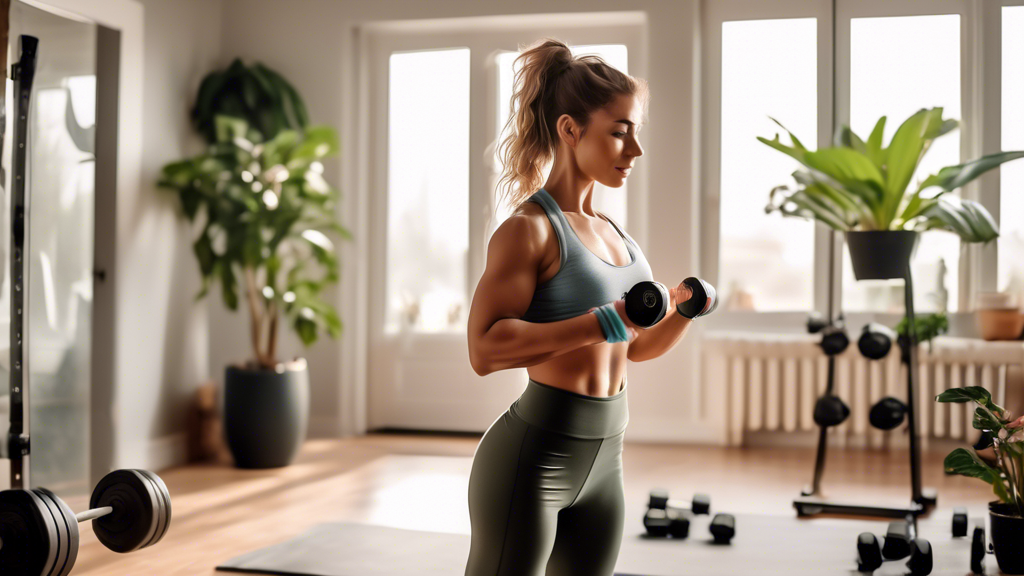
Training your biceps at home effectively requires understanding what actually loads the bicep — pulling movements — and which home-available tools and exercises provide that load. Here’s a complete guide: exercises, progressions, and a weekly program you can start with what you have.
How Biceps Actually Work
Your biceps contract when you flex your elbow (curl) and when you supinate your forearm (palm turns upward). They work most effectively when they’re under load through the full range of that motion. Pulling movements — rows, chin-ups, curls — are how you load them.
The most effective bicep training is not isolation-first. Compound pulling (chin-ups, rows) builds more mass than isolated curling, particularly for beginners. Add isolation work after your main pulling is done.
The Exercises, Ranked by Effectiveness
1. Chin-Up (Best Bodyweight Option)
Underhand grip (palms toward you), hands shoulder-width. Pull until chin clears the bar. 3–5 × AMRAP.
If you can’t do one yet: use a resistance band looped over the bar for assistance, or do negatives (jump to top, lower over 5 seconds).
2. Resistance Band Curl
Stand on the middle of the band, one end in each hand, palms up. Curl both hands to shoulders. Squeeze at top. Lower over 2–3 seconds. 3 × 12–15.
The band provides more resistance at the top of the curl (full contraction) than the bottom — this is actually advantageous compared to free weights, which are hardest at 90 degrees.
3. Doorway Row
Grip the door frame, walk feet forward, pull chest to frame. Biceps do significant work. Can be done with no equipment beyond a door. 3 × 10–15.
4. Dumbbell Curl (If You Have Dumbbells)
Standard curl, palms up. Focus on the lowering phase (2–3 seconds down). Don’t swing. 3 × 10–12.
5. Hammer Curl (Bands or Dumbbells)
Palms facing inward throughout the curl. This shifts emphasis to the brachialis (the muscle under the bicep that pushes the peak up) and brachioradialis (forearm). 3 × 10–12.
6. Concentration Curl (Bands or Dumbbells)
Seated, elbow resting on inner thigh, curl one arm. Eliminates momentum. Pure bicep isolation. 3 × 10 per arm.
A 3-Day Bicep Program
Train biceps 2–3× per week with at least 48 hours between sessions:
Day A (Strength focus):
- Chin-Up: 4 × AMRAP
- Band Curl (slow): 3 × 10
- Hammer Curl: 3 × 10
Day B (Volume focus):
- Doorway Row: 3 × 15
- Band Curl (regular pace): 4 × 12
- Concentration Curl: 3 × 10 per arm
Day C (optional — intensity):
- Chin-Up: 3 × AMRAP with 10-second rest-pauses
- Band Curl with 4-second negative: 3 × 8
Progressive Overload Without a Gym
- More reps: Increase from 10 to 12 to 15 before adding resistance
- Slower eccentrics: 2-second lowering → 3-second → 4-second
- Heavier bands: Move to the next resistance level when current reps feel easy
- More volume: Add a set (3 → 4 → 5 sets) before changing any other variable
What to Expect
With 2–3 sessions per week and adequate protein (0.7–1g/lb bodyweight daily), noticeable bicep size changes occur within 8–12 weeks. Strength increases come faster (3–4 weeks). Chin-up max reps is the best single metric for tracking bicep development — measure it every 4 weeks.
Free tools to put this into practice
Build a full program around your goal, or plan the gear to support it — both are free and need no sign-up.
AI Workout Plan Builder
Home Gym Equipment Advisor
See all tools →

Written by
Simple Home Workout Editorial Team
Articles are written and edited by the Simple Home Workout editorial team. Content is researched using established exercise and fitness guidance and edited for clarity, practicality, and home-workout use. This is general educational information, not personalized medical, dietetic, or fitness advice.
View all posts →