Family Fitness at Home: Activities That Get Everyone Moving

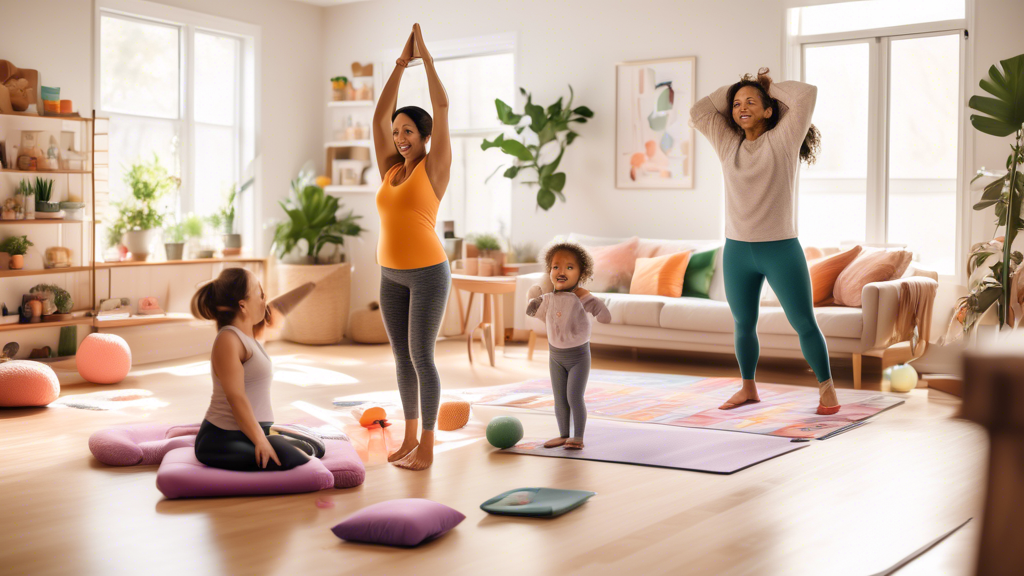
A vibrant scene in a sunny park featuring a happy family engaged in different fitness activities. Parents and children are seen running, biking, playing so

The biggest barrier to family fitness isn’t motivation — it’s that most “family workout” content assumes young children want to do structured exercise. They don’t. They want to play. The trick is making movement the game, not a chore tacked onto the game.

For Families With Young Kids (Ages 3–8)

Animal Walk Circuit

Move between rooms or across the yard as different animals: bear crawl (hands and feet), crab walk (hands and feet, belly up), frog jumps, duck walk (squat hold while walking). Kids love this. You get a genuine lower body and core workout. Do 3–4 rounds of 2 minutes each.

Freeze Dance

Play music, dance around the room, freeze when the music stops. Anyone who moves is “out” (or does 5 jumping jacks to get back in). 15–20 minutes burns real calories and involves zero resistance to participation from kids.

Obstacle Course

Use pillows, chairs, jump rope lines on the floor, hula hoops. Crawl under, jump over, balance along. Time it with a phone. Kids want to beat their previous time. Parents do the course too. Build a new one each week.

Backyard Games

Frisbee, soccer, tag, and relay races all provide legitimate cardiovascular activity for children and adults. The key is playing alongside them, not supervising from the sidelines.

For Families With Older Kids (Ages 9–14)

Challenge Ladders

A written list on the fridge: push-up challenge (who can do the most), plank hold (who can hold the longest), broad jump (measure with tape). Update the family records. Friendly competition is a powerful motivator for this age group.

Team Workout Games

Card-based workouts work well with older kids: draw a card, suits correspond to exercises (hearts = push-ups, diamonds = squats, clubs = jumping jacks, spades = sit-ups), number is the reps. Go through half the deck. Total time: 20–25 minutes.

Active Video Games

Not the same as sedentary gaming. Ring Fit Adventure, Just Dance, Wii Sports, and similar titles require real physical movement. 30 minutes of Ring Fit is comparable to a light gym session for most adults. Useful for rainy days.

For the Whole Family Together

Weekend Hikes

Any trail rated “easy” or “moderate” is appropriate for most families. Start with 30–45 minute hikes and build distance over weeks. Benefits: cardiovascular fitness, exposure to nature, no screen time, and a natural conversation context for parents and kids.

Bike Rides

Even a 20-minute neighborhood loop provides meaningful cardiovascular exercise. Helmet required. Aim for once a week minimum during warm months.

Family Yoga or Stretching

10–15 minutes of following a YouTube yoga video together before bed improves flexibility, reduces stress for both kids and adults, and builds a calming end-of-day routine. Many children’s yoga videos are specifically designed to be engaging for ages 5+.

Making It Stick

The families that maintain activity long-term don’t schedule “family workouts.” They schedule activities the family enjoys that happen to involve movement. Find what your kids actually like — the movement follows naturally. Change activities by season to avoid boredom. And do the activities with them, not just near them.

Home Workouts for Stay-at-Home Parents: Routines That Fit Into Your Actual Day

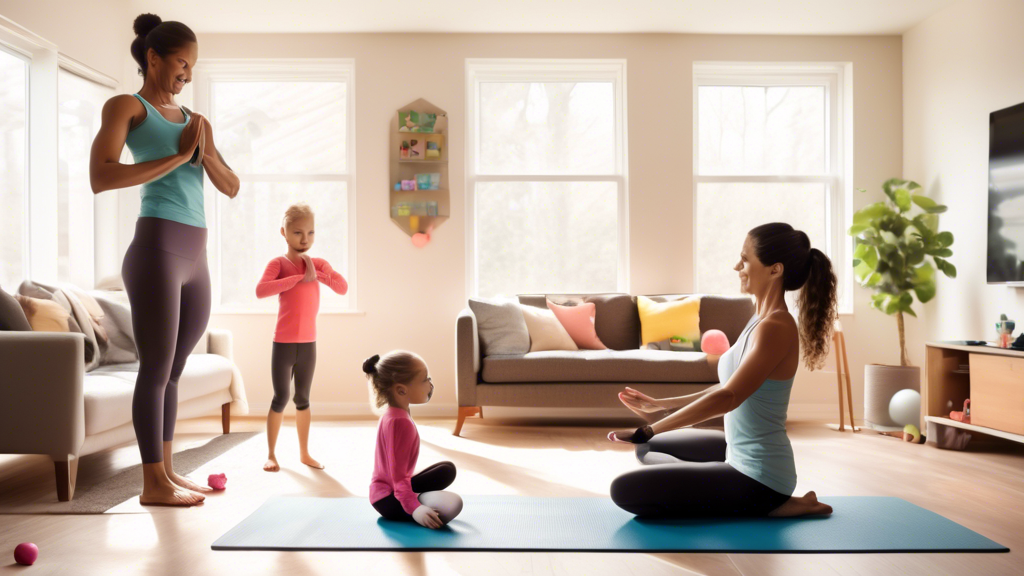
Create an image showing a stay-at-home parent performing a workout routine in their living room. The parent is engaging in exercises while watching over a

The standard advice for staying fit as a stay-at-home parent — “wake up an hour early” or “work out during naptime” — ignores that naps are unpredictable, early mornings are already brutal, and most workouts assume you have 45 uninterrupted minutes. Here’s what actually works.

The Core Problem: Fitness Advice Assumes You Have Time Blocks

Most workout programs are designed for people who can block out 30–60 minutes reliably. Stay-at-home parents often can’t. The solution isn’t a different program — it’s a different structure: workouts designed to be completed in segments, resumed after interruption, or done with a kid in the room.

Strategy 1: The 10-Minute Micro-Workout

Three 10-minute sessions spread through the day is just as effective as one 30-minute session, according to exercise physiology research. The key is making each session count.

A complete 10-minute routine:

  • Push-ups: 3 sets of as many as possible (AMRAP) with 30 seconds rest
  • Bodyweight squats: 3 × 15
  • Plank: 2 × 30 seconds

Do this once in the morning, once midday, once in the evening. That’s 30 minutes of training without needing a continuous block.

Strategy 2: Naptime Workouts (When They Happen)

Naptime workouts work best when you have a pre-loaded routine that starts immediately — no deciding what to do, no warming up for 10 minutes. Have one go-to workout ready:

The 20-Minute Naptime Circuit (3 rounds):

  • Jump squats × 10 (or bodyweight squats if noise is a concern)
  • Push-up to downward dog × 8
  • Reverse lunges × 10 per leg
  • Mountain climbers × 20
  • Superman hold × 5 (hold 3 seconds each)

Rest 60 seconds between rounds. Total time: ~20 minutes.

Strategy 3: Workout With Your Kids

This works better than most parents expect. Kids 2 and up can follow simple movement games. Make the workout a game:

  • Follow the leader: You do squats, they do squats. You do bear crawls, they do bear crawls.
  • Obstacle course: Set up pillows and furniture. Crawl over, jump around, balance on one foot. You’re doing it too.
  • Resistance with a toddler: Hold your kid on your chest during squats (baby squat). Push them in a stroller for interval walking. Let them sit on your back for a “mommy/daddy push-up.”

These aren’t full workouts by themselves, but they add meaningful movement on days when nothing else is possible.

The Minimal Equipment Setup That Fits Any Space

For stay-at-home parents, bulky home gym equipment usually becomes a storage problem. The most useful items by size-to-value ratio:

  • Resistance band set (~$15–25): Dozens of exercises, stores in a drawer
  • Doorframe pull-up bar (~$25): Rows, chin-ups, hanging core work
  • Yoga mat (~$20): Comfortable floor work

That’s ~$60 and fits in a small closet.

Building a Realistic Weekly Schedule

Stop trying to follow a standard 5-day program. Instead, commit to a minimum: 3 days per week, at least 20 minutes each. Everything beyond that is a bonus.

  • Monday: Upper body (push-ups, band rows, band curls) — 20–25 min
  • Wednesday: Lower body (squats, lunges, glute bridges) — 20–25 min
  • Friday: Core + cardio (plank variations, mountain climbers, jump squats) — 20 min

This is sustainable. A 5-day program you abandon after two weeks accomplishes nothing. Three consistent days accomplishes a lot.

On Consistency vs. Perfection

Some weeks you’ll get all three sessions. Some weeks you’ll get one. Both are fine. The parents who maintain fitness long-term aren’t the ones who never miss a session — they’re the ones who return quickly after missing one. Lower the bar enough that you can always clear it.

Time-Saving Home Workouts: Effective Routines for 10, 15, and 20 Minutes

A busy professional in a sleek, modern apartment doing a quick, high-intensity interval training (HIIT) workout, with a timer on the wall showing just a fe

The length of a workout matters far less than how it’s structured. A 10-minute session with the right format produces real results; a 45-minute session with too much rest and the wrong exercises doesn’t. Here are five routines at three different time lengths — pick the one that fits your day.

Why Short Workouts Actually Work

Two mechanisms drive fitness results: mechanical tension (load on muscles) and metabolic stress (accumulation of work in the muscle). Short workouts can deliver both if you keep rest periods tight, use compound movements that work multiple muscle groups, and structure the session as a circuit rather than a standard rest-heavy routine.

The 10-Minute Workout (No Rest Between Exercises)

For days when 10 minutes is genuinely all you have. Two rounds of five exercises with no rest within rounds, 60 seconds between rounds.

2 rounds, no rest between exercises, 60 sec between rounds:

  • Squat × 12
  • Push-up × 8
  • Reverse lunge × 8 per leg
  • Plank × 20 sec
  • Glute bridge × 12

Total: ~10 minutes. Every major muscle group gets work.

The 15-Minute HIIT Workout

High-intensity intervals for maximum calorie burn. Tabata format: 20 sec work, 10 sec rest, 8 rounds = 4 min per exercise pair.

3 rounds × 5 minutes (work/rest 40/20):

  • Squat jump ↔ push-up (alternate each interval)
  • Mountain climber ↔ reverse lunge
  • Burpee ↔ plank hold

This is genuinely difficult. Scale by replacing jump squat with bodyweight squat and burpee with inchworm if needed.

The 15-Minute Strength Circuit

If high impact isn’t appropriate (joint issues, late evening, apartment), this circuit builds strength without jumping.

3 rounds, 40 sec work / 20 sec rest:

  • Slow squat (3 sec down, 1 sec hold, 2 sec up)
  • Push-up
  • Single-leg glute bridge
  • Plank shoulder tap
  • Dead bug

The 20-Minute Full-Body Workout

The most complete option. Four supersets of two exercises — one push, one pull or lower body.

4 supersets, 3 rounds each, 30 sec rest between supersets:

  • Superset 1: Push-up × 10 + Squat × 15
  • Superset 2: Table row × 10 + Reverse lunge × 10 per leg
  • Superset 3: Pike push-up × 8 + Glute bridge × 15
  • Superset 4: Diamond push-up × 8 + Mountain climbers × 20 sec

The 20-Minute Morning Mobility + Strength Routine

For people who want to start the day moving without high intensity. Combines mobility work with light strength.

  • Cat-cow × 10
  • Hip flexor stretch × 30 sec per side
  • Leg swing × 10 per leg
  • Bodyweight squat × 12
  • Bird dog × 8 per side
  • Inchworm × 6
  • Glute bridge × 15
  • Plank × 30 sec

Run through twice. No intensity, just movement — useful for rest days or days when energy is low.

How to Choose

Routine Best for
10-minute circuit Genuinely packed days — better than skipping
15-min HIIT Fat loss, cardiovascular fitness
15-min strength Muscle building without impact
20-min full body Most balanced results
20-min morning Rest days, mobility maintenance

The best workout is the one you actually complete. On tough days, the 10-minute option beats nothing. On good days, the 20-minute full-body option is the most productive use of time.

Quick Home Workouts for Busy Parents: Real Routines That Fit Into Actual Parenting Schedules

A vibrant scene showing busy parents in a cozy living room, engaging in quick workout routines. One parent is doing jumping jacks while watching their todd

Parenting schedules don’t give you a predictable 45-minute window four times a week. They give you a 12-minute nap overlap on Tuesday, a 20-minute block while kids watch a show on Thursday, and the occasional full half-hour on Saturday. The routines below are built around that reality.

The Core Challenge: Unpredictable Time Windows

The biggest mistake in parent fitness advice is assuming you have a fixed block of time every day. Most busy parents don’t. What they have is variable blocks of 10–30 minutes with no guarantee of continuity. The solution is having a menu of routines at different lengths that you can pull from depending on what’s available that day.

The 10-Minute Nap Window Workout

For the overlap where one child is asleep and the other is occupied. No warm-up time to spare — start immediately, keep it compact.

2 rounds, move immediately between exercises:

  • Squat × 15
  • Push-up × 10
  • Reverse lunge × 8 per leg
  • Glute bridge × 15
  • Plank × 20 sec

Rest 45 sec between rounds. Done in under 10 minutes. Every major muscle group gets one set per round.

The 20-Minute “They’re Watching TV” Workout

For a longer uninterrupted block. Three supersets, more volume.

3 rounds, 30 sec rest between supersets:

  • Squat × 12 + Push-up × 10
  • Romanian deadlift (bodyweight) × 10 + Table row × 10
  • Reverse lunge × 10 per leg + Dead bug × 8 per side

~18–20 minutes total including rest. Covers all major muscle groups.

The Workout You Do With Your Kids

When you can’t find time away from your kids, make it together. Children 3+ can follow simple movements and find it genuinely fun. Frame it as a game.

  • “Frog jump” (jump squat) × 8
  • “Bear crawl” across the room × 2
  • “Plank high-five” — hold a plank, high-five your child who’s standing in front of you
  • “Superhero landing” — jump squat with soft landing
  • “Mountain climbers race” — who can do more in 20 seconds

You get movement and resistance; they get exercise, coordination practice, and they associate fitness with fun — which sets them up well for life.

Staying Consistent When Schedules Are Unpredictable

Lower the minimum, not the target. Committing to “I will work out 4 times this week for 45 minutes” fails the moment a child is sick, a work call runs long, or you haven’t slept. Committing to “I will do something active every day, even if it’s 8 minutes” maintains the habit through the chaos. Habits survive disruption when the minimum threshold is achievable on hard days.

Morning is the most reliable window. Before the household’s needs fully activate, before school runs and work calls, there’s often 15–20 quiet minutes. For many parents, this is the most consistent training window. It requires going to bed 20 minutes earlier — which is worth it.

Track what you actually do, not what you planned. A workout journal that shows 22 sessions in the last month — even if many were 12 minutes — is more motivating than a plan you only hit 8 times.

Realistic Expectations

Three 20-minute sessions per week produce real fitness results. It’s not optimal by textbook standards, but it’s entirely sufficient for maintaining and gradually improving cardiovascular health, muscular strength, and body composition. The goal isn’t perfection — it’s consistency over months and years.

Beginner Bodyweight Workout for Small Spaces: 5 Exercises, 20 Minutes, No Equipment

A cozy, modern living room with a person performing bodyweight exercises like squats, lunges, and push-ups. The space is small but well-organized, with a y

You don’t need much space to start working out — a 4×6 foot area and 20 minutes is enough for a complete beginner session. This routine covers all major muscle groups using only bodyweight movements that fit within that footprint. If you’re new to exercise or returning after a long break, start here.

Before You Start

Three things to check:

  • Clear the area of anything you can step on or bump into
  • Use a yoga mat or towel if the floor is hard or slippery
  • Have water nearby — you’ll need it

The 5-Exercise Circuit

These five exercises cover your legs, push muscles, posterior chain, core, and pulling muscles. They require nothing beyond your bodyweight and a 4×6 foot space.

Exercise 1: Bodyweight Squat

Feet shoulder-width, chest up. Lower until thighs are parallel to the floor (or as deep as comfortable). Drive through heels to return. This is the foundational lower body movement.

Beginner: 3 × 10 reps

If squatting to parallel is uncomfortable: Squat to a chair (sit lightly, stand back up) until mobility improves.

Exercise 2: Knee Push-Up

From a kneeling plank position, lower your chest toward the floor and press back up. Keep your body in a straight line from knees to head — no raised hips, no sagging core.

Beginner: 3 × 8 reps

Progress to: Full push-up when you can complete 3 × 10 knee push-ups with perfect form.

Exercise 3: Glute Bridge

Lie on your back, feet flat and hip-width, knees bent. Drive hips upward, hold 2 seconds at the top, lower. Trains your glutes, hamstrings, and lower back stabilizers.

Beginner: 3 × 12 reps

Exercise 4: Standing Calf Raise

Hold a wall or chair for balance. Rise onto toes as high as possible, hold 1 second, lower fully. Full range matters more than speed.

Beginner: 3 × 15 reps

Exercise 5: Dead Bug

Lie on your back, arms pointing to ceiling, knees bent at 90°. Slowly lower one arm overhead and the opposite leg toward the floor while pressing your lower back flat. Return and switch sides. Trains deep core stability.

Beginner: 3 × 6 per side

The 20-Minute Session Plan

  • Warm-up (3 min): March in place → arm circles → hip circles → 5 slow squats
  • Circuit (15 min): Complete all 5 exercises back-to-back. Rest 20 sec between exercises, 75 sec between rounds. Do 3 rounds.
  • Cool-down (2 min): Standing quad stretch → seated hamstring stretch → deep breathing

Common Beginner Mistakes

  • Going too fast. Slow, controlled reps build more strength and are safer than rushing. If you’re bouncing through squats, slow down.
  • Skipping the cool-down. 2 minutes of stretching significantly reduces next-day soreness, especially in the first few weeks.
  • Stopping when sore. Mild soreness 24–48 hours after your first sessions is normal. Train through it (at lower intensity if needed) rather than waiting until you feel 100%.

Frequency and Progress

Start with 3 sessions per week with at least one day between each. After 2 weeks, progress by: adding 1–2 reps per exercise, or reducing rest between exercises to 15 sec, or moving to harder variations (full push-up, single-leg glute bridge). After 4–6 weeks of this routine, you’ll be ready for a more demanding beginner program.

The Traveler’s Bodyweight Workout: A 20-Minute Hotel Room Session

A fit traveler in a sunny park doing bodyweight squats with a suitcase nearby, with city landmarks in the background.

Hotel rooms impose specific constraints: small floor space (typically 6×8 feet of clear area), hard floors that transmit sound to the room below, no equipment, and sometimes guests on each side who don’t want to hear jumping. This routine works within all those limits.

The Hotel Room Rules

  • No jumping exercises — impact travels through floors and walls
  • Movements must fit in 6×8 feet or less
  • Nothing bolted to the floor (no pull-up bars) — use the bed or chair for support exercises
  • Low noise ceiling (fellow travelers can hear you)

The 20-Minute Hotel Workout

Two rounds of this circuit. Rest 15 sec between exercises, 90 sec between rounds.

Round A: Lower Body

Slow squat — 12 reps (3 sec down, 2 sec hold, 2 sec up): No jumping, but the controlled tempo creates significant quad and glute demand. Louder than you’d think at normal speed; the slow version is quiet.

Romanian deadlift (bodyweight) — 10 per leg: Single-leg hinge, reach hands toward the floor as the back leg extends. Near-silent. Excellent hamstring and glute work.

Hip thrust on the bed — 15 reps: Shoulders on the edge of the bed, feet flat on the floor, drive hips up. The soft surface actually helps here — less floor contact pressure, quieter movement.

Calf raise (slow) — 20 reps: Stand at the edge of the bed for balance. 2 sec up, 2 sec down. Full range.

Round B: Upper Body + Core

Push-up — 10 reps: Standard. If the floor is carpeted, it’s comfortable without a mat.

Tricep dip on bed — 10 reps: Hands on bed edge, legs extended. Quiet, effective.

Pike push-up — 8 reps: Inverted V position, lower head toward floor. Trains shoulders — useful when you can’t do overhead presses.

Dead bug — 8 per side: Completely silent. On the floor next to the bed. Great for lower back care after travel sitting.

Plank — 30 sec: Hold or add shoulder taps.

The Travel Recovery Circuit (10 Minutes)

After long flights or drives, your hip flexors, thoracic spine, and hamstrings are typically compressed and tight. Run this instead of or before the workout:

  • Hip flexor stretch (low lunge) — 45 sec per side
  • Thoracic rotation (seated, hands behind head, rotate each direction) — 10 per side
  • Hamstring stretch (seated on bed edge, straighten one leg) — 30 sec per side
  • Cat-cow — 10 reps
  • Ankle circles — 10 each direction per ankle

Making It Count on Short Trips

Maintaining fitness during travel is far easier than rebuilding it afterward. Even one 20-minute session every two days during a work trip preserves most of your strength and cardiovascular capacity. The goal while traveling is maintenance, not progress — and this routine handles that well.