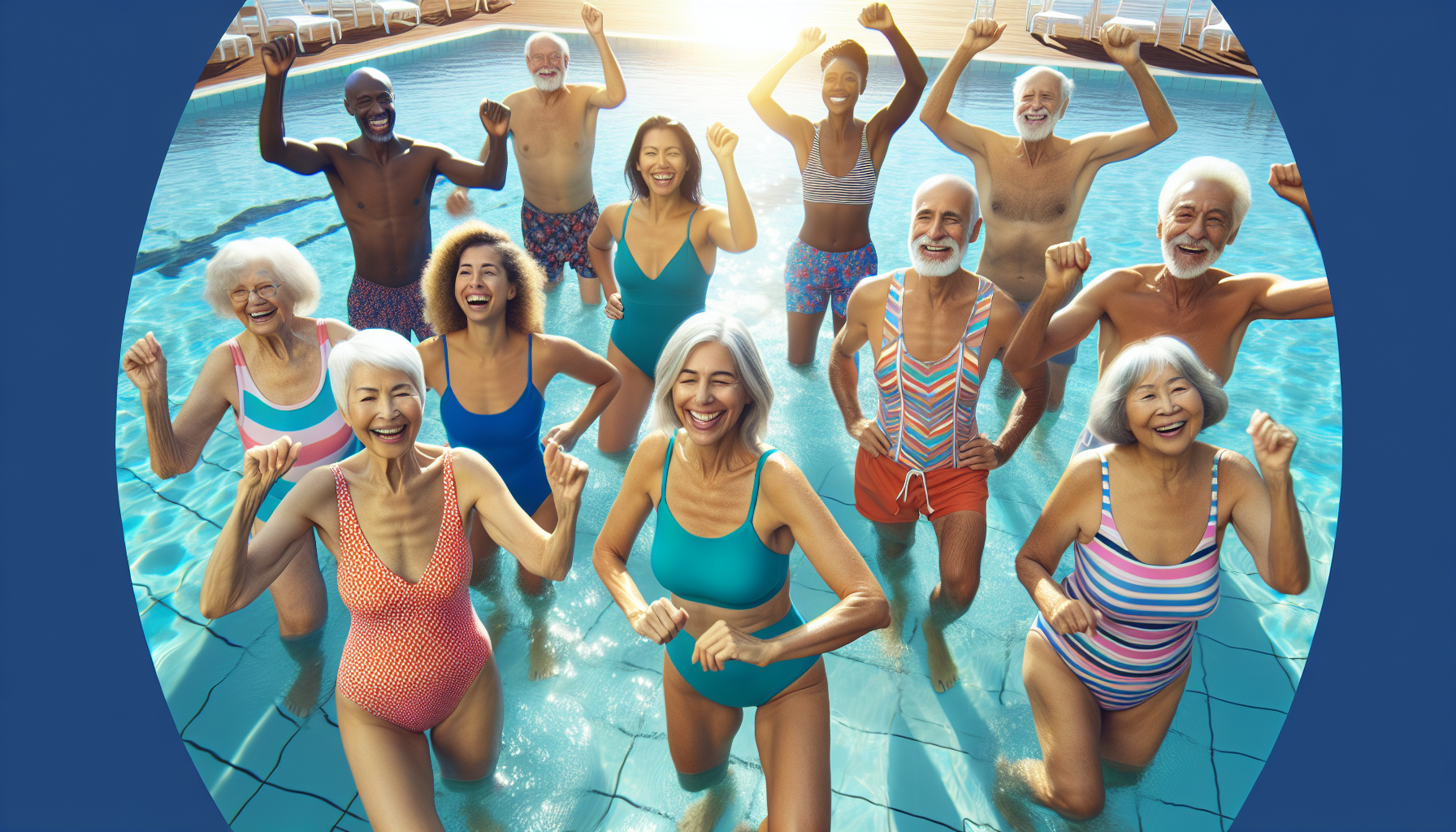
Water aerobics takes place in a pool, typically in chest-deep water, and involves cardio, strength, and range-of-motion movements against water resistance. For seniors — particularly those with arthritis, joint pain, or mobility limitations — it’s often the most comfortable exercise option available because water buoyancy reduces effective body weight by roughly 90%, eliminating almost all joint impact.
Note: Water aerobics requires access to a pool. Community pools, YMCAs, senior centers, and recreation centers are the most common venues. Class costs typically range from $5 to $15 per session, with membership discounts often available.
What the Research Shows
Studies consistently show that water aerobics produces cardiovascular improvements comparable to land-based exercise at the same intensity while creating significantly less joint stress. For older adults specifically, it reduces osteoarthritis pain, improves balance and gait, maintains bone density (less effectively than weight-bearing exercise, but meaningfully), and provides social engagement that supports mental health and long-term adherence.
Why Water Is Particularly Good for Seniors
Buoyancy eliminates impact: The force that damages aging joints — the landing force of every step — doesn’t exist in water. You can move your legs and arms vigorously without the repetitive impact that wears on knees, hips, and ankles on land.
Water resistance is automatic: Move your arm slowly through water and it provides little resistance. Move it quickly and resistance increases proportionally. This means you automatically exercise at the intensity you’re capable of — the water self-regulates. You can’t accidentally overdo it the way you can with weights.
Fall risk is reduced: In chest-deep water, a stumble doesn’t result in a fall — the water catches you. For seniors who are anxious about falling during exercise, this removes a significant barrier to participation.
Temperature regulation: A cool pool lowers core temperature, allowing people who overheat easily to exercise for longer than they could on land.
Common Water Aerobics Exercises
Cardiovascular Movements
Water walking: Walk forward, backward, and sideways through chest-deep water. More resistance than air walking — it’s a genuine workout at brisk pace. Start here if you’re new to water exercise.
Water jogging: Jog in place or across the pool. The buoyancy makes this dramatically lower-impact than land jogging while the resistance makes it harder cardiovascularly.
Flutter kick: Hold a kickboard (provided at most pools) and kick your legs in alternating short kicks. Targets the hip flexors and quadriceps without upper body load.
Strength Movements
Arm push and pull: Stand in chest-deep water. Push both arms forward through the water, then pull them back. Repeat for 30 to 60 seconds. Water resistance provides the load — move faster for more resistance.
Water leg lifts: Stand near the pool wall, hold the edge. Lift one leg to the side, return. Lift it forward, return. Lift it back, return. Targets all hip muscle groups.
Water wall push-up: Face the pool wall, hands on the edge at shoulder width. Lean in, push back. Equivalent to an incline push-up.
Flexibility and Range-of-Motion
Hip circles: Hold the pool wall, circle one leg slowly at the hip joint. Full range of motion in all directions.
Ankle circles: In the water, rotate each ankle through its full range. Water supports the leg, allowing complete focus on the ankle movement.
What to Expect From Your First Class
Most water aerobics classes are 45 to 60 minutes. Instructors stand at pool deck (they don’t get in), lead the movements, and provide modifications. The class will almost certainly feel social — regular attendees tend to be community-oriented, and the group format is a significant part of what makes water aerobics an activity people sustain for years.
Bring: swimsuit, water shoes (optional but helpful on slippery pool decks), towel, and a water bottle — you still need to hydrate in a pool.
Getting Started
Call your nearest YMCA, community recreation center, or senior center and ask about water aerobics class schedules. Many offer senior-specific sessions at lower-demand times of day. If no classes are available in your area, individual lap swim time and a YouTube water aerobics follow-along session can accomplish the same thing independently — you just need pool access.
Aim for 2 to 3 sessions per week to see meaningful improvement in cardiovascular fitness and joint comfort within 6 to 8 weeks.
Free tools to put this into practice
Build a full program around your goal, or plan the gear to support it — both are free and need no sign-up.
AI Workout Plan Builder
Home Gym Equipment Advisor
See all tools →

Written by
Simple Home Workout Editorial Team
Articles are written and edited by the Simple Home Workout editorial team. Content is researched using established exercise and fitness guidance and edited for clarity, practicality, and home-workout use. This is general educational information, not personalized medical, dietetic, or fitness advice.
View all posts →