Pilates Core Training: From Foundation to Intermediate Exercises

A modern Pilates studio with a serene, minimalist design. A diverse group of people in athletic wear are engaging in a variety of core-strengthening exerci

Pilates core training builds strength progressively — foundational exercises establish the body awareness and deep core activation that more advanced work requires. Skipping the foundation and jumping to harder movements is the most common mistake beginners make, and it produces worse results than building the sequence correctly.

The Principle: Control Before Load

Pilates prioritizes controlled movement with the deep core engaged before adding difficulty. This means learning to activate the transverse abdominis (the deep stabilizing layer), coordinate breathing with movement, and maintain a neutral spine before moving to exercises that challenge these capacities under greater load.

Foundation Level (Weeks 1–3)

Master these before progressing. They look easy; they are not when done correctly.

Imprinting

Lie on your back with knees bent, feet flat. Find neutral spine — the natural curve of your lower back. Breathe in to expand your ribcage, exhale fully and draw your navel gently toward your spine. This engagement of the transverse abdominis is what Pilates calls “centering.” Practice until it becomes automatic before adding any exercise on top of it. 5 min daily.

Leg Slides

From the imprint position, exhale and slide one heel away from your body until the leg is almost straight. Return on the inhale. Your pelvis must not move at all. This is harder than it sounds. 2 × 10 per leg.

Pelvic Curl

From neutral spine, exhale and slowly peel your spine off the mat starting from the tailbone, vertebra by vertebra, until you’re in a bridge position. Inhale at top, exhale to lower the same way. The sequential articulation teaches each spinal segment to move independently. 3 × 8.

The Hundred (Modified)

Head and shoulders curled up, knees bent and lifted to 90°. Pump arms and breathe: 5 short inhales, 5 short exhales. Start with 5 breath cycles (50 pumps) and build to 10 (100 pumps). 2–3 sets.

Intermediate Level (Weeks 4–8)

Begin these when foundation exercises feel controlled and automatic.

Single-Leg Stretch

Head and shoulders curled up. Pull one knee to chest while the other leg extends. Alternate, maintaining still hips and stable torso. 3 × 10 alternating reps.

Double-Leg Stretch

Head and shoulders up, both knees pulled to chest. Extend arms overhead and legs simultaneously (to 45°), then circle arms back to hug knees. The challenge is maintaining the curl and not letting your lower back arch at full extension. 3 × 8.

Spine Stretch Forward

Seated with legs extended. Inhale to lengthen the spine, exhale to round forward one vertebra at a time, reaching toward your feet. Inhale, exhale to roll back to upright. Improves spinal mobility and deep core activation in a non-supine position. 3 × 6.

Criss-Cross

Bicycle-like motion with full thoracic rotation. Bring one elbow toward the opposite knee while extending the other leg. Pause 1 second at the top of each rotation. Rotate from the ribcage, not just the elbow. 3 × 8 per side.

Common Mistakes at Both Levels

  • Gripping with the hip flexors instead of using the core. If your lower back arches or your legs shake, you’ve moved beyond your core’s current capacity. Raise your leg angle or bend your knees.
  • Holding your breath. The breathing IS the exercise in Pilates. Exhale on the effort, inhale on the recovery.
  • Moving through range of motion without control. A small range done with complete control is more effective than a large range done sloppily.
Pilates for Abs and Core: 6 Exercises That Build Deep Core Strength

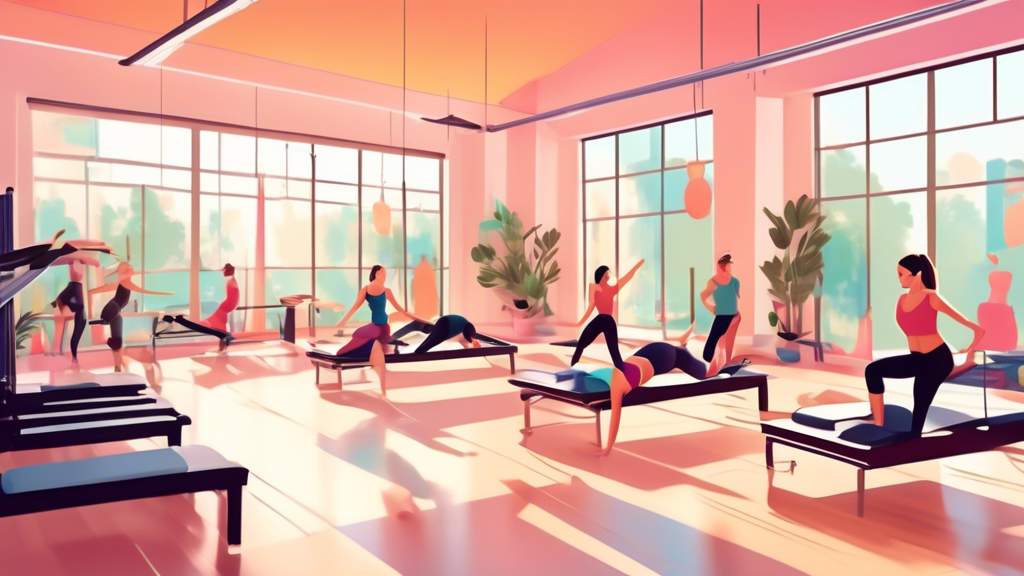
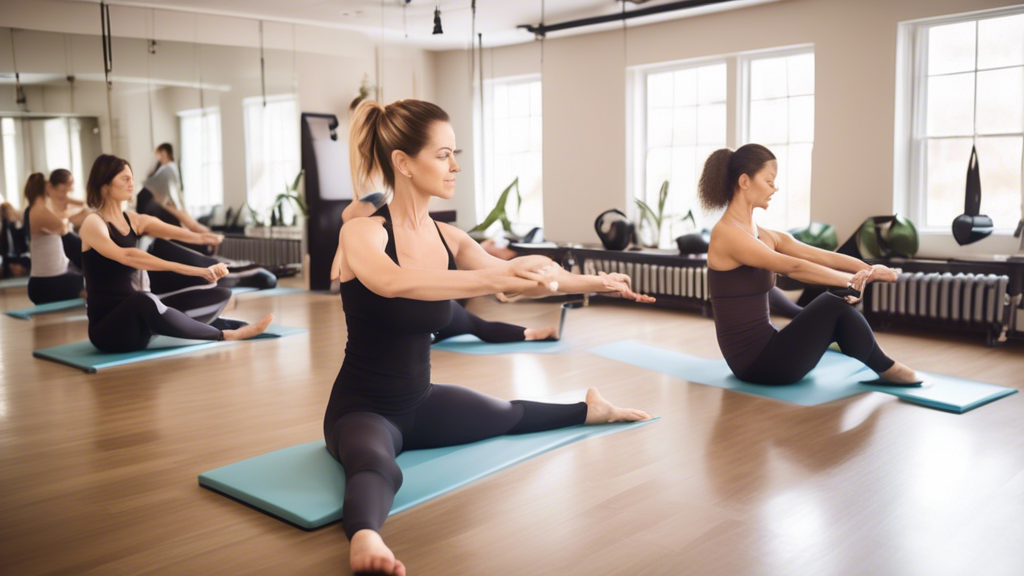
A brightly lit, modern Pilates studio with people engaging in various Pilates exercises focused on abs and core strengthening. The backdrop includes large

Pilates doesn’t just work your abs — it trains the entire deep core system that stabilizes your spine and transfers force through your body. The six exercises below are the most effective in the Pilates repertoire for this purpose, with instructions for both beginners and those with some Pilates experience.

Why Pilates Builds a Different Kind of Core Strength

Most ab training works the rectus abdominis (the surface six-pack muscle) through spinal flexion — crunches, sit-ups, leg raises. Pilates prioritizes the transverse abdominis (the deepest layer), the obliques, and the muscles that stabilize the spine in neutral — producing functional core strength that transfers to every movement you make.

The result is a core that’s stronger from the inside out: better posture, less lower back pain, and more efficient movement in everyday activities and exercise.

Exercise 1: The Hundred

Curl head and shoulders off the mat, extend legs to 45° (or keep knees bent). Arms by sides, pump them in short pulses — 5 inhales, 5 exhales per 10 pumps. Complete 100 pumps.

Beginner: Knees bent, head on mat if neck tires → Intermediate: Legs extended at 45°, held strongly

Exercise 2: Roll-Up

Lie flat, arms overhead. Inhale to prepare, exhale and curl up vertebra by vertebra until sitting upright, reach forward. Inhale, exhale to roll back the same way. Never use momentum.

3 × 5. This is harder than it looks — many people can’t complete a full Roll-Up initially without hip flexors taking over. Start with knees bent until spinal articulation improves.

Exercise 3: Leg Circles

Lie on your back, one leg extended to the ceiling. Circle the leg across the body, down, out, and back up. The entire circle should leave your pelvis completely still. 5 circles each direction per leg, 2 sets.

The deep hip stabilizers and obliques work continuously to prevent the pelvis from rocking — this is the training goal, not just the hip mobility.

Exercise 4: Double-Leg Stretch

Head and shoulders curled up, both knees pulled to chest. Inhale, extend arms overhead and legs to 45°. Exhale, circle arms and pull knees back in. The moment of full extension is where the deep core is maximally challenged — don’t let your lower back arch.

3 × 8. Raise leg angle if lower back arches at 45°.

Exercise 5: Scissors

Curl up with both legs extended. One leg reaches toward the ceiling while the other lowers toward the floor. Hold the upper leg, pulse it twice, then switch. Pelvis stays perfectly still as legs alternate.

3 × 6 per side. Excellent for the deep hip flexors and lower abdominals working together.

Exercise 6: Teaser

Lie flat, arms overhead. Simultaneously raise legs to 45° and curl your torso up until you form a V-shape — upper body and legs balancing on your tailbone. Pause, then slowly return to flat. This is the most challenging exercise here — it requires full core strength, hip flexor strength, and balance.

3 × 5. Modify by keeping knees bent until you can manage straight legs.

A Complete Pilates Core Session (25 Minutes)

  • Imprinting + breathing — 3 min
  • Hundred — 2 sets
  • Roll-Up — 3 × 5
  • Leg Circles — 2 × 5 per direction, per leg
  • Double-Leg Stretch — 3 × 8
  • Scissors — 3 × 6 per side
  • Teaser — 3 × 5 (or modification)
  • Spine Stretch Forward — 3 × 5

Practice 3× per week. Pilates rewards patience — the control and precision improve over weeks, and so do the results.

5 Best Pilates Exercises for Core Strength: A Beginner’s Step-by-Step Guide

A serene fitness studio with soft, natural lighting, showcasing a diverse group of individuals engaged in a variety of Pilates exercises specifically targe

Pilates is one of the most effective approaches to building a strong, stable core — but the exercises look deceptively simple and are often done incorrectly by beginners. This guide breaks down the five most effective Pilates core exercises with precise instructions, common mistakes, and beginner modifications for each.

Before You Start: The Pilates Breath

In Pilates, breathing is technique, not just breathing. The pattern is: inhale to prepare, exhale on the effort. Each exhale should be fully complete — this activates the deep transverse abdominis automatically, which is the primary muscle Pilates targets. Practice this breathing before adding any exercise.

Exercise 1: The Hundred

What it builds: Core endurance, breath coordination, deep abdominal engagement

How to: Lie on your back. Curl head and shoulders off the mat. Arms reach long by your sides. Pump arms in small, controlled beats — 5 beats inhale, 5 beats exhale = 1 breath cycle. Complete 10 breath cycles (100 beats).

Beginner modification: Keep knees bent and feet flat on the mat rather than extending legs.

Common mistake: Lifting with the neck instead of the core. If your neck tires first, place your head on the mat and focus only on the breath and arm pump.

Exercise 2: The Roll-Up

What it builds: Spinal articulation, hamstring flexibility, sequential core control

How to: Lie flat, arms reaching overhead. Inhale, then exhale as you peel your spine off the mat starting from your head — one vertebra at a time — until you’re sitting upright reaching over your legs. Inhale, then exhale to roll back down the same way.

Beginner modification: Bend knees slightly to reduce hamstring demand. Use a towel behind your thighs to assist the roll-up phase.

Common mistake: Using momentum to “throw” yourself up. If you can’t roll up without momentum, your spinal flexibility is limited — the exercise is still worth doing slowly with assistance.

Exercise 3: Single-Leg Stretch

What it builds: Oblique strength, anti-rotation stability, hip flexor endurance

How to: Lie on your back, curl head and shoulders up. Pull your right knee to your chest while your left leg extends to 45°. Switch. Maintain a still torso as the legs alternate — no rocking, no hip rotation. 3 × 10 alternating reps.

Beginner modification: Keep the extended leg higher (60–70° from floor) to reduce demand on the core.

Common mistake: Letting the hips rock side to side as you switch legs. The pelvis should be completely still throughout.

Exercise 4: Leg Circles

What it builds: Deep hip stability, pelvic stability, hip joint mobility

How to: Lie on your back, one leg extended to ceiling, other leg flat on mat. Circle the raised leg across your body, down, out, and back to center — keeping the pelvis completely still. 5 circles each direction. Switch legs. 2 sets.

Beginner modification: Make the circles small — perhaps 6 inches in diameter initially. Increase size only as you can maintain pelvic stability.

Common mistake: Letting the pelvis rock with each circle. The entire point of the exercise is not letting it move.

Exercise 5: Spine Stretch Forward

What it builds: Spinal flexion mobility, posterior chain awareness, seated core stability

How to: Sit upright with legs extended and slightly wider than hip-width. Inhale to lengthen the spine tall. Exhale as you slowly round forward from your head down through each vertebra, reaching hands toward feet. Inhale, then exhale to roll back to upright. 3 × 6.

Beginner modification: Sit on a rolled mat or blanket to tilt your pelvis slightly forward if tight hamstrings make upright sitting difficult.

Common mistake: Bending from the hips (hip flexion) instead of the spine (spinal flexion). The rounding should start from the top of the head and progress downward.

A Complete 20-Minute Beginner Pilates Session

  • Breathing practice — 3 min
  • Hundred (modified) — 2 sets of 50 pumps
  • Roll-Up — 3 × 5
  • Single-Leg Stretch — 3 × 10
  • Leg Circles — 2 × 5 per direction, per leg
  • Spine Stretch Forward — 3 × 6

Practice 3× per week. Progress shows in control and precision rather than difficulty — when you can do all five exercises with full control and no compensations, the exercises produce more results, not less.

Pilates Core Routine for Beginners: 5 Exercises With Step-by-Step Instructions

A serene fitness studio setting with soft natural light filtering through large windows. A person in form-fitting athletic wear is performing a Pilates rou

If you’re new to Pilates, the most important thing to know is that the quality of each movement matters more than how many exercises you do. A beginner doing three exercises with full control and correct breathing gets more benefit than someone rushing through ten moves without the fundamentals. This routine gives you five foundational exercises with detailed instructions.

The Fundamentals Before You Start

Finding Neutral Spine

Lie on your back with knees bent. There should be a small space under your lower back — that’s neutral spine. Not pressing flat to the floor (posterior tilt), not arching dramatically (anterior tilt). This is the starting position for most Pilates exercises and the position your spine should maintain throughout.

The Pilates Breath

Breathe in through your nose, expanding your ribcage sideways. Breathe out through your mouth, drawing your navel gently in toward your spine. On the exhale, your deep core activates automatically. Practice this 5 times before starting the exercises.

Exercise 1: Imprinting

Purpose: Teaches pelvic control and activates the deep core

Lie on your back in neutral spine. On the exhale, press your lower back gently into the mat (posterior tilt), then on the inhale return to neutral. Do this 10 times slowly. This activates the transverse abdominis and pelvic floor — the foundation of everything else. Spend 3 minutes here before moving on.

Exercise 2: Pelvic Curl

Purpose: Spinal articulation, glute activation, core sequencing

From neutral spine, exhale and begin to curl your tailbone off the mat, then each vertebra progressively until you’re in a bridge with only your shoulders and head on the mat. Inhale at the top. Exhale to lower vertebra by vertebra back to neutral — tailbone last. Every vertebra should peel off and return separately. 3 × 6 reps.

If any segment of your spine “clumps” instead of rolling, that area needs more mobility work — do the exercise anyway, slowly.

Exercise 3: Leg Slides

Purpose: Core stability with limb movement — the core’s primary real-world function

From neutral spine with both knees bent, exhale and slowly slide one heel away from you along the mat until the leg is nearly straight. Inhale, then exhale to return. Your pelvis must not move at all throughout. This looks trivially easy; with perfect pelvic stability, it is genuinely challenging. 2 × 10 per leg.

Exercise 4: The Hundred (Beginner Version)

Purpose: Core endurance, breath coordination

Lie on your back, knees bent, feet flat. Exhale and curl your head and shoulders off the mat (like a crunch, but hold the position). Arms long by your sides. Pump your arms in small controlled beats — 5 short inhales for 5 pumps, 5 short exhales for 5 pumps. Aim for 50 pumps (5 full breath cycles) to start, building to 100 over weeks. Lower your head if your neck tires.

Exercise 5: Single-Leg Stretch

Purpose: Oblique anti-rotation, coordination, hip flexor endurance

Stay curled up from the Hundred. Pull your right knee toward your chest with both hands while extending your left leg to 45°. Switch legs in a controlled rhythm — left knee in, right leg out. Your torso stays completely still. 3 × 8 alternating reps.

If 45° is too demanding, extend the leg to 60° or higher until core strength builds.

The Complete Beginner Session (20 Minutes)

  1. Breathing practice — 3 min
  2. Imprinting — 10 reps, slow
  3. Pelvic Curl — 3 × 6
  4. Leg Slides — 2 × 10 per leg
  5. Hundred (beginner) — 2 sets of 50 pumps
  6. Single-Leg Stretch — 3 × 8
  7. Spine Stretch Forward (seated) — 3 × 5

Practice 3 times per week. After 3–4 weeks, the control and breath coordination will feel natural, and you’ll be ready to add the Roll-Up, Leg Circles, and Double-Leg Stretch from the intermediate repertoire.

Pilates Core Workout: A Complete 30-Minute Session With Form Cues

A serene studio with large windows letting in natural light, showcasing a group of diverse individuals engaged in a Pilates core workout on mats. They are

This is a complete Pilates core session structured as a workout — warm-up, eight exercises with specific form cues, and cool-down. It takes about 30 minutes if you follow the rest periods.

You need a mat. The session is suitable for beginners comfortable lying on the floor and for intermediate exercisers who want a focused core session. No Pilates background required.

The Key Concept: What Pilates Actually Targets

Most ab exercises — crunches, sit-ups, leg raises — work the rectus abdominis, the outermost abdominal layer. Pilates targets the transverse abdominis (deep inner abs), multifidus (deep spinal stabilizers), and pelvic floor. These muscles stabilize the spine before movement happens, which is why Pilates produces a different quality of core strength than conventional ab training.

Before each exercise, practice this: exhale and gently draw your lower belly in and up — about 30% effort, not a hard vacuum. This activates the transverse abdominis. Hold this engagement throughout each movement.

Warm-Up (5 Minutes)

Cat-cow — 10 reps. On hands and knees. Inhale, drop the belly and lift the chest (cow). Exhale, round the spine toward the ceiling (cat). Move slowly through each vertebra.

Pelvic tilt — 10 reps. Lie on your back, knees bent. Exhale and press your lower back gently into the mat, then inhale and release to neutral. This small movement teaches you what neutral spine feels like.

Child’s pose with reach — 30 seconds. Sit back onto heels, reach arms forward on the mat. Breathe into your lower back.

The Eight Exercises

1. The Hundred

Targets deep core, hip flexors, and breathing coordination.
Lie on your back. Curl head and shoulders up. Extend legs to 45 degrees — raise them higher if your lower back arches off the mat. Arms reach long beside your hips, pump them vigorously up and down. Inhale for 5 pumps, exhale for 5. Complete 100 pumps total.
Form cue: The back staying flat is the priority. Raise legs to 60 or 70 degrees if needed to maintain it.

2. Roll-Up

Targets abdominal flexors and spinal mobility.
Lie flat, arms overhead. Inhale. Exhale and peel your spine off the mat slowly — each vertebra lifts separately, not all at once. Reach toward your feet. Inhale at the top. Exhale to lower back down the same way. 8 reps.
Form cue: This is not a sit-up. If you can’t roll up with control, start with hands behind your knees and assist yourself.

3. Single Leg Stretch

Targets deep abs, hip flexors, coordination.
Curl head and shoulders up. Pull one knee toward your chest, extend the other leg at 45 degrees. One hand on your ankle, one on your knee. Alternate with a rhythmic pull. 10 reps per side.
Form cue: Lower back stays pressed into the mat. If it’s arching, raise the extended leg higher.

4. Double Leg Stretch

Targets core stability and coordination.
Both knees pulled to chest. Curl head and shoulders up. Inhale and extend both arms overhead and both legs to 45 degrees simultaneously. Exhale and circle arms back to hug knees in. 8 reps.
Form cue: The moment you extend is the moment the core must work hardest. Don’t relax it as you reach out.

5. Criss-Cross

Targets obliques and rotational core stability.
Hands behind head. Curl up. Rotate your right shoulder toward your left knee while extending your right leg. Switch sides. 10 reps per side.
Form cue: Rotate from the ribcage, not just the elbow. Think about bringing your armpit toward the opposite knee.

6. Spine Stretch Forward

Targets spinal mobility and hamstring flexibility.
Sit tall with legs extended hip-width apart. Exhale and round your spine forward while keeping your hips grounded. Inhale to sit back up. 8 reps.
Form cue: You’re actively flexing your spine and pulling your belly back toward your spine as you reach forward — not just flopping over.

7. Swan Prep

Targets spinal extensors and rear shoulders — a necessary counterbalance to all the forward flexion above.
Lie face down, hands under shoulders. Inhale. Exhale and press through your hands to lift your chest — elbows remain bent, forearms stay on the mat. Hold 2 seconds, lower. 8 reps.
Form cue: Lead with your sternum, not your chin. Shoulders stay away from your ears.

8. Bird Dog

Targets the multifidus (deep spinal stabilizers) and glutes.
On all fours, hands under shoulders, knees under hips, spine neutral. Exhale and extend your right arm forward while extending your left leg back simultaneously. Hold 3 seconds, return with control. Alternate sides. 10 per side.
Form cue: Keep your hips level — no rotation. A common error is letting the lifted-leg hip drop or rise.

Cool-Down (5 Minutes)

  • Lying knee-to-chest hug: 30 seconds per side
  • Happy baby pose: 30 seconds
  • Savasana, breathing slowly: 2 minutes

How Often to Do This Session

Two to three times per week with at least one rest day between. Pilates core work is recovery-friendly — it doesn’t create the muscle damage that heavy lifting does — but the nervous system benefits from rest between sessions to consolidate movement patterns. It pairs well as a finisher to other workouts or as a standalone active recovery session.

Why Pilates Builds a Stronger Core Than Most Ab Workouts: 5 Key Exercises

A serene, modern studio with large windows overlooking a lush garden. A group of diverse individuals are in the midst of a Pilates class, focusing on a var

Most ab workouts — crunches, sit-ups, leg raises — train the rectus abdominis, the outermost abdominal muscle. This is the muscle visible as a “six pack.” Pilates targets something different: the transverse abdominis (the deep inner abs), the multifidus (deep spinal stabilizers), and the pelvic floor. These muscles stabilize the spine before movement happens — they’re why a strong core actually prevents back pain and improves athletic performance.

This article explains what those muscles do, why they matter, and gives you five exercises that specifically target them, with the form cues that make the difference between going through the motions and actually training the right muscles.

The Core Muscles Most Workouts Miss

Transverse abdominis (TVA)
The deepest abdominal layer. Wraps around your torso like a corset. Activates before any limb movement to brace the spine — it fires in anticipation of load, not in reaction to it. When it’s weak, larger muscles compensate, creating a less stable, more injury-prone pattern.

Multifidus
Small muscles running alongside each vertebra. Provide intersegmental stability — they control how individual vertebrae move relative to each other. People with chronic lower back pain consistently show reduced multifidus size and activation on the affected side. Pilates and bird-dog exercises are the primary tools rehabilitation specialists use to retrain them.

Pelvic floor
The base of the core. Works with the TVA, multifidus, and diaphragm to maintain intra-abdominal pressure. Affects bladder control, hip stability, and core force transfer.

What Pilates Does Differently

Pilates exercises require you to maintain a stable spine and pelvis while moving your limbs. This forces the deep stabilizers to work continuously — not just at the peak of a movement. Add breath control (exhale on exertion, inhale to prepare) and you’re also coordinating the diaphragm with the rest of the system. It’s more neurologically demanding than a crunch, which is why people who’ve done years of ab work often find Pilates unexpectedly difficult.

5 Exercises That Target Deep Core Muscles

1. Dead Bug

Primary muscles: transverse abdominis, multifidus
Lie on your back. Arms toward ceiling, knees at 90 degrees above hips (tabletop). Press your lower back firmly into the mat — this is critical and must be maintained throughout. Exhale and slowly extend your right arm overhead while simultaneously extending your left leg. Keep the back pressed down. Return and switch sides.
Why it targets deep core: Maintaining a stable spine while extending opposite limbs is exactly the anti-extension, anti-rotation demand that forces TVA and multifidus activation.
Reps: 3 sets of 8 per side

2. Heel Slide

Primary muscles: transverse abdominis, lower abdominals
Lie on your back, knees bent, feet flat, lower back pressing gently into the mat. Exhale and slowly slide one heel along the floor, fully straightening that leg, while keeping the lower back from arching. Slide it back. Alternate sides.
Why it targets deep core: One of the most direct TVA exercises available. The slow limb movement while holding a pressed lower back isolates the deep core with minimal rectus abdominis involvement.
Reps: 3 sets of 10 per side

3. The Hundred

Primary muscles: TVA, hip flexors, breathing coordination
Lie on your back. Curl head and shoulders up. Extend legs to 45 degrees (raise them higher if your back arches). Arms reach long at hip height, pump up and down vigorously. Inhale 5 pumps, exhale 5 pumps. 10 breath cycles equals 100 pumps.
Why it targets deep core: The combination of limb extension load and forced breathing pattern coordinates the full deep core system in a way static exercises don’t.
Reps: Start with 30 pumps, build to full 100

4. Single-Leg Circle

Primary muscles: TVA, hip stabilizers
Lie on your back. Extend one leg toward the ceiling. Draw small circles with the extended leg — crossing center, down, around, and back up. Keep the pelvis completely still. 5 circles each direction per leg.
Why it targets deep core: Any weakness in the deep stabilizers shows immediately as a rocking or shifting pelvis. The exercise gives you real-time feedback on your stability.
Reps: 3 sets of 5 circles each direction per leg

5. Bird Dog

Primary muscles: multifidus, TVA, glutes
On all fours. Hands under shoulders, knees under hips, spine neutral. Extend your right arm forward and left leg back simultaneously. Hold 3 seconds. Return with control, switch sides. Keep hips level — no rotation.
Why it targets deep core: The anti-rotation demand specifically activates the multifidus. This is why it appears in nearly every physical therapy protocol for lower back rehabilitation.
Reps: 3 sets of 10 per side

Adding These to Your Routine

These five exercises work well as a 15-minute standalone routine or as a core finisher after any other workout. Do them 2 to 3 times per week. Unlike high-intensity ab circuits, they don’t require significant recovery time — the deep stabilizers respond well to frequent, controlled practice at moderate effort.