Best Bodyweight Exercises for Small Spaces: Ranked by Footprint and Effectiveness

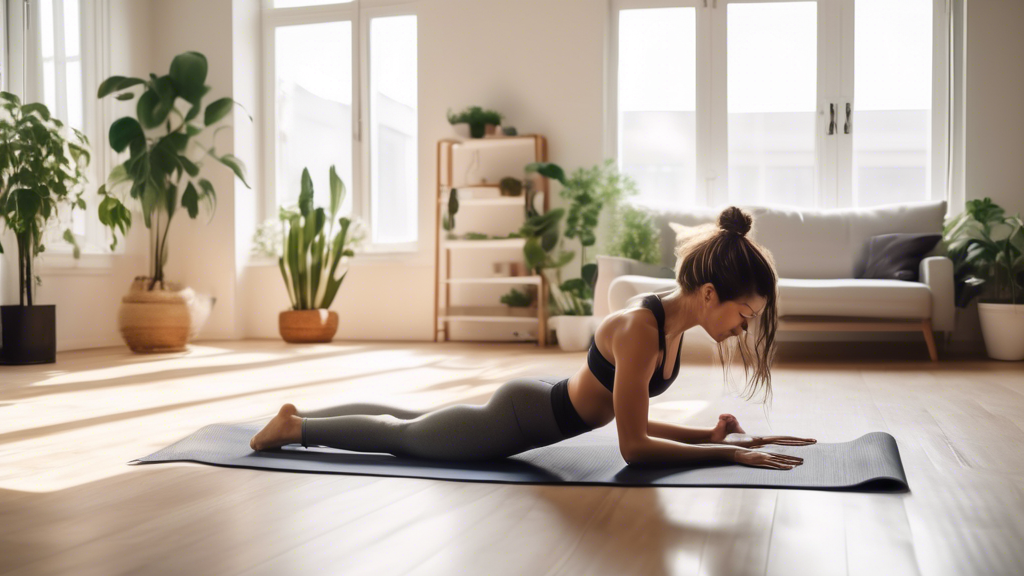
Create an image of a person performing various bodyweight exercises in a small, cozy living room. The scene features a comfortable sofa, a coffee table, an

Not all bodyweight exercises fit in small spaces equally. A forward lunge travels more floor space than a reverse lunge. A burpee requires you to go from standing to fully prone and back. Side shuffles need lateral room many rooms don’t have.

This guide ranks exercises by floor footprint and training value so you can build a workout that fits where you actually are.

Zero Extra Footprint — Stand in Place

Bodyweight squat
Footprint: Your standing position
Effectiveness: Very high — quads, hamstrings, glutes, core
One of the best small-space exercises. Scales from beginner (standard squat) to advanced (single-leg squat, jump squat) without moving an inch.

Standing hip hinge
Footprint: Your standing position
Effectiveness: High — hamstrings, glutes, lower back
Essential posterior chain work. Push hips back while keeping back flat, stand back up. Often skipped in home workouts, which leads to quad-dominant imbalances.

Calf raise
Footprint: Your standing position
Effectiveness: Moderate — calves, ankle stability
Hold a wall for balance. Single-leg version doubles the demand.

High knee march
Footprint: Your standing position
Effectiveness: Moderate — hip flexors, low-impact cardiovascular
The best cardio option for very small spaces and apartment situations. No lateral movement, no impact.

Small Footprint — Body Length Only

Push-up
Footprint: Body length, lying down
Effectiveness: Very high — chest, triceps, shoulders, core
The most versatile small-space exercise. Wide-grip, close-grip, pike, decline, explosive — dozens of variations on the same mat.

Plank
Footprint: Body length
Effectiveness: High — deep core, shoulders, stability
Progression happens through time, instability, and movement (shoulder taps, leg lifts) without needing more space.

Glute bridge
Footprint: Body length
Effectiveness: High — glutes, hamstrings, lower back
One of the most underrated small-space exercises. Single-leg version is genuinely difficult.

Superman hold
Footprint: Body length, lying face down
Effectiveness: Moderate — spinal extensors, glutes, rear shoulders
Important for balance — most small-space workouts are front-dominant. This counters that.

Reverse lunge
Footprint: One step backward
Effectiveness: High — quads, glutes, hamstrings, balance
Requires only a step back instead of forward, making it more space-efficient than a standard lunge. Equally effective.

Medium Footprint — Full Mat Required

Mountain climber
Footprint: Body length, low lateral spread
Effectiveness: High — core, hip flexors, cardiovascular
Entirely mat-based. Good cardio without lateral movement or jumping. Can be done quietly.

Burpee (modified)
Footprint: Body length plus 2 to 3 feet
Effectiveness: Very high — full-body strength and conditioning
Can be adapted for small spaces by stepping out and in rather than jumping. Reduces both footprint and noise significantly.

Inchworm
Footprint: Body length with some forward travel
Effectiveness: Moderate — hamstrings, core, shoulder stability, warm-up
Best used as warm-up. Can minimize travel by walking hands back rather than stepping forward.

What to Avoid in Small Spaces

Forward lunges (travel forward), jumping jacks (lateral spread), side shuffles (lateral travel), and standard burpees with jumps all require more room than most apartments provide. Replace them with their small-space equivalents above.

Sample 25-Minute Small-Space Circuit

Three to four rounds, 60 seconds rest between rounds:

  • Bodyweight squat: 15 reps
  • Push-up: 12 reps
  • Glute bridge: 15 reps
  • High knee march: 45 seconds
  • Reverse lunge: 10 per side
  • Plank hold: 30 seconds

Apartment Bodyweight Workout: How to Train Without Disturbing Your Neighbors

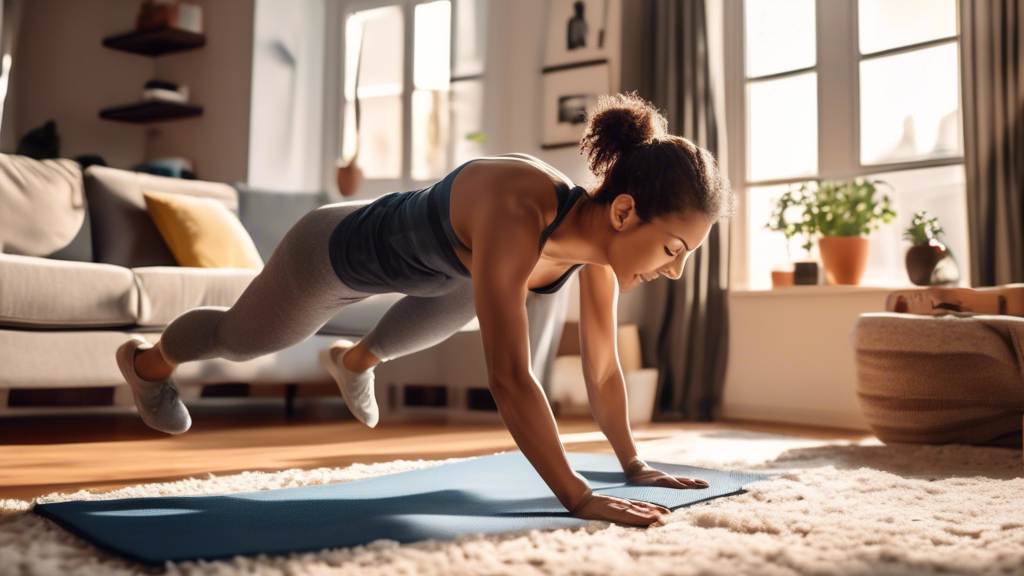
A cozy apartment living room with a person performing various bodyweight exercises like push-ups, squats, and lunges. The apartment is well-lit with natura

Training in an apartment has one constraint that standard home workout guides don’t address: impact travels through floors. Jump squats, burpees with jumps, and jumping jacks create noise that reaches neighbors below more than most people expect. This guide gives you a full-body bodyweight workout built specifically around that constraint — effective training that doesn’t require noise management.

The Core Principles

No jumping in the main sessions. Jump-based exercises are replaced with low-impact equivalents that produce similar training effects without floor impact.

Slow eccentrics are quiet and harder. Lowering slowly — 3 to 4 seconds on the way down — increases time under tension significantly. A slow-lowering squat is harder than a standard squat and completely silent. This is the primary tool for increasing intensity without adding impact.

Floor exercises are the quietest option. Push-ups, planks, glute bridges, and other mat-based movements produce essentially no floor noise. When you need complete quiet — late at night, early morning — shift toward floor-only variations.

The Complete Apartment Workout

3 rounds, 45 seconds rest between rounds. Takes 25 to 30 minutes.

Lower Body

Slow squat (3-second lower) — 12 reps
Take 3 full seconds to lower, then stand back up at normal speed. The slow eccentric loads the quads and glutes more effectively than a standard squat. No impact, no noise.

Reverse lunge — 10 reps per side
Step backward rather than forward. More space-efficient, less forward instability. Both knees reach 90 degrees at the bottom.

Glute bridge — 15 reps
Lie on back, drive hips up through your heels. Single-leg version for more difficulty. Entirely floor-based and silent.

Wall sit — 45 seconds
Slide down a wall until thighs are parallel to the floor. Static hold. Completely quiet, high quad demand, requires no movement at all.

Single-leg calf raise — 15 reps per side
Hold a wall for balance. Lower slowly — 2 to 3 seconds down.

Upper Body

Push-up — 12 reps
Standard or with variations: wide-grip emphasizes chest, close-grip emphasizes triceps, pike push-up targets shoulders. The most versatile quiet upper body exercise.

Tricep dip — 12 reps
Use a sturdy chair. Hands on seat edge, feet extended or bent, bend elbows to lower, press up.

Pike push-up — 8 reps
Hips high in an inverted V, lower your head toward the floor between your hands, press back up. More shoulder emphasis than a standard push-up.

Table row — 10 reps
Lie under a sturdy table, grip the edge, pull your chest toward the underside. Keep your body straight. Effective back and bicep exercise using only furniture.

Core

Plank hold — 30 to 45 seconds
Forearms or hands. No impact, no sound. The best core-to-noise ratio of any exercise.

Dead bug — 8 reps per side
Lie on back. Extend opposite arm and leg while pressing your lower back into the mat. Works deep stabilizers.

Glute bridge with march — 12 reps
Hold the top of a glute bridge, lift one foot a small amount off the floor, alternate. Adds anti-rotation demand.

Low-Impact Cardio for Apartments

Cardiovascular work without jumping requires some creativity:

  • High knee march: Lift knees to hip height vigorously. Controlled and quiet but genuinely elevates heart rate with sustained effort.
  • Shadow boxing: Jab, cross, hook, uppercut combinations. Gets heart rate up with zero floor impact. Add movement and pivoting for more intensity.
  • Step-ups: Step up onto a bottom stair or a low, sturdy box. Alternate legs for 60 seconds. Step rather than jump for low noise.
  • Squat-to-stand circuit: String slow squats, standing oblique crunches, and hip hinges together continuously for 20 minutes. More cardio effect than it sounds.

Timing Considerations

Even low-impact exercises produce some foot-strike and movement noise. Most building quiet-hours rules cover 10 PM to 7 or 8 AM. If your schedule requires late-night training, the floor exercises — planks, push-ups, glute bridges, dead bugs — produce essentially no sound and are your best options during those hours. Save the squat and lunge variations for daytime sessions.

Chair Exercises: A Complete Seated Workout Routine for Every Fitness Level

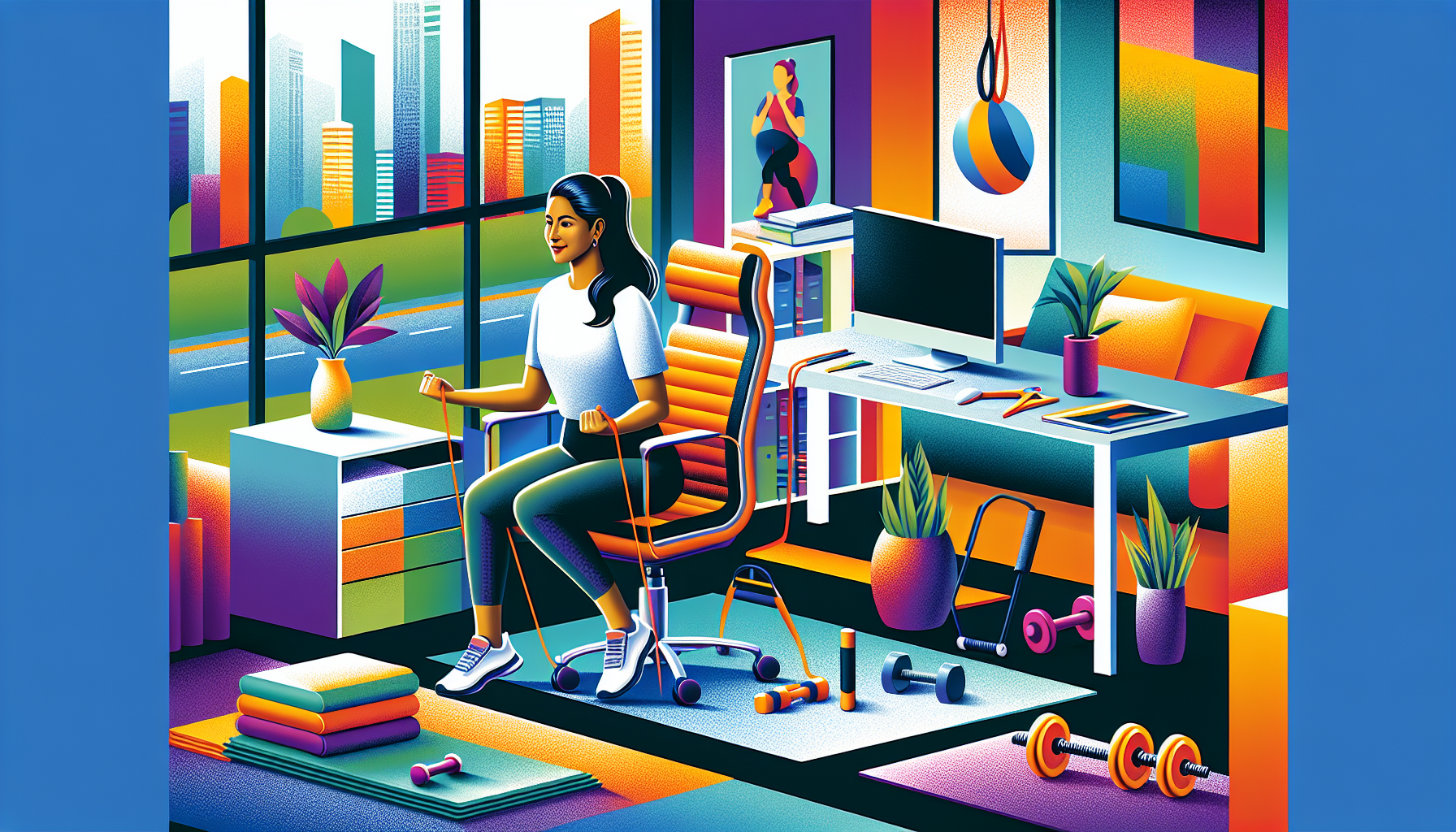
A person doing a fitness workout sitting on a chair in an office setting with exercise equipment around them.

Chair exercises let you train your upper body, lower body, and core while staying seated. They’re appropriate for people with limited mobility, balance concerns, or joint pain — and for anyone who spends long hours sitting and wants to counteract the effects. You don’t need a special chair: any stable, armless chair with four legs works.

If you have a specific medical condition, check with your doctor or physical therapist before starting, particularly if you have recent joint surgery, a heart condition, or severe osteoporosis.

What Chair Exercises Can and Can’t Do

Chair exercises can build meaningful upper body and leg strength, improve circulation, maintain range of motion, and support cardiovascular health when done at sufficient intensity and frequency. They won’t build the same muscle mass as standing or free-weight training, but for people who need a seated option, they produce real fitness gains. Consistency matters more than intensity at the outset.

The Complete Chair Workout

3 rounds of the full circuit, resting 60 seconds between rounds. Total time: 25 to 30 minutes.

Warm-Up (5 Minutes)

  • Seated march — 60 seconds. Lift knees alternately, as high as comfortable. Swing arms.
  • Neck rolls — 5 slow circles each direction. Stop if you feel pain.
  • Shoulder rolls — 10 forward, 10 backward.
  • Ankle circles — 10 each direction per ankle. Improves circulation in the lower legs.

Upper Body

Seated push-up — 12 reps.
Hands on the armrests or seat edge. Press your body up slightly, hold 2 seconds, lower. Targets triceps and shoulders. If your chair has no armrests, place hands on knees and press down as you straighten your elbows.

Overhead press — 12 reps.
Hold light weights (canned goods, water bottles) at shoulder height. Press overhead until arms are straight, lower. Targets shoulders and upper arms.

Bicep curl — 12 reps.
Hold weights at your sides, palms forward. Curl toward your shoulders, lower slowly.

Seated row — 12 reps.
Hold a resistance band (or a towel looped around a door handle at seat height). Pull your elbows back behind you, squeezing your shoulder blades. Targets upper back and biceps.

Lower Body

Seated leg extension — 15 reps per leg.
Sit tall. Straighten one leg fully, hold 2 seconds, lower. Targets quadriceps. Add an ankle weight for more difficulty.

Chair squat (sit-to-stand) — 12 reps.
Scoot forward to the edge of the seat. Cross arms over chest. Stand up using leg power — no pushing off the armrests. Sit back slowly and under control. This is one of the most functional exercises for seniors — it directly trains the movement required to get up from any seated surface.

Seated hip abduction — 15 reps per side.
Sit with feet flat. Lift one knee out to the side, return. Targets outer glutes and hip muscles essential for walking stability.

Calf raise (seated) — 20 reps.
Feet flat on floor. Raise heels as high as possible, lower slowly. Important for circulation and lower leg strength.

Core

Seated trunk rotation — 10 reps per side.
Cross arms over chest. Rotate your upper body to the right as far as comfortable, return to center, rotate left. Keep hips facing forward throughout.

Seated knee-to-chest — 10 reps per side.
Hold the sides of the seat for support. Bring one knee toward your chest, hold 2 seconds, lower. Works hip flexors and lower abs.

Seated side bend — 10 reps per side.
Reach one arm overhead, bend to the opposite side, return. Targets obliques and lateral trunk muscles.

Cool-Down (5 Minutes)

  • Seated hamstring stretch: extend one leg, hinge forward at the hip. 30 seconds per side.
  • Seated chest opener: clasp hands behind your back, gently draw shoulders back. 30 seconds.
  • Seated neck stretch: tilt head toward one shoulder, hold 20 seconds. Switch sides.

How Often to Do This Workout

3 times per week with at least one rest day between sessions. As strength improves over 4 to 6 weeks, increase resistance (heavier canned goods, thicker resistance band) rather than adding more exercises. Progression through resistance drives continued improvement.

Making It Harder Over Time

Once 3 rounds feel manageable: add a 4th round; slow the lowering phase of each exercise to 3 seconds; add resistance via canned goods, water bottles, or resistance bands; reduce rest between rounds to 45 seconds. These adjustments extend progress without requiring new exercises.

Tai Chi for Seniors: What the Research Shows and How to Start at Home

A serene senior citizen practicing Tai Chi in a tranquil garden with blooming cherry blossoms.

Tai chi is a slow, flowing movement practice originating in Chinese martial arts. For seniors, it’s one of the most evidence-supported exercises for fall prevention, balance improvement, and cognitive function. The movements are low-impact, can be adapted for people with limited mobility, and don’t require equipment or significant space.

Check with your doctor before starting if you have severe osteoporosis, recent joint replacement, or significant balance impairment that creates fall risk during standing practice.

What the Research Actually Shows

The evidence for tai chi in older adults is stronger than for most complementary practices:

  • Fall prevention: A 2019 systematic review of 18 studies found tai chi reduced fall rates by 20 to 45% in older adults. The CDC includes tai chi in its evidence-based fall prevention programs.
  • Balance: Regular tai chi practice improves static balance (standing still) and dynamic balance (moving) more than conventional balance exercises in most comparison studies.
  • Cognitive function: Studies show improvement in executive function, attention, and processing speed after 12 to 24 weeks of regular practice.
  • Blood pressure: Meta-analyses show moderate reductions in systolic blood pressure (approximately 7 mmHg), comparable to low-intensity aerobic exercise.
  • Joint pain: For knee osteoarthritis, tai chi reduces pain comparably to physical therapy in randomized controlled trials.

The Core Principles You Need to Understand

Slow, continuous movement: Every transition is controlled. Speed is reduced to the point where balance must be maintained throughout, not just at the start and end of each movement.

Weight shifting: Most tai chi movements involve shifting weight from one leg to the other. This constant challenge to stability is why the practice improves balance — it trains exactly the moment when falls happen (during movement, not while standing still).

Relaxed posture: Shoulders down, knees slightly bent, spine tall. Tai chi is practiced in a partial squat position that builds leg strength over time without loading the joints.

Breath coordination: Movements are coordinated with breathing — typically exhaling on the “outward” phase of a movement and inhaling as you prepare for the next.

How to Start at Home

Tai chi is best learned visually. Two practical starting options:

  1. YouTube — Dr. Paul Lam’s Tai Chi for Arthritis: A widely used beginner program designed specifically for older adults. The first four movements can be learned in a few sessions and provide real fall-prevention benefit on their own.
  2. Community classes: Many senior centers, YMCAs, and community centers offer tai chi classes at low or no cost. In-person instruction allows posture correction that videos cannot provide. Even 6 to 8 in-person sessions to learn the basics, followed by home practice, is a good approach.

The 5 Basic Movements to Learn First

From the Sun Style — one of the most accessible for beginners:

  1. Opening and closing hands: Stand with feet shoulder-width, arms at sides. Slowly raise arms to shoulder height as if floating, lower back down while opening and closing hands. Simple weight and balance practice.
  2. Step and reach forward: Step one foot forward, shift weight onto it while reaching both arms forward. Step back, shift weight back. Trains the exact weight-shifting pattern that prevents stumble falls.
  3. Cloud hands: Slowly move both hands in alternating horizontal circles at chest height while shifting weight side to side. Improves lateral balance and upper body coordination.
  4. Parting the wild horse’s mane: Step diagonally while one hand rises and the other lowers, as if separating something in front of you. Builds hip stability and single-leg balance.
  5. Wave hands like clouds: Gentler version of cloud hands. Suitable for days when you want lower-intensity practice.

How Much Practice You Need

Studies showing balance and fall prevention benefits typically used 2 to 3 sessions per week for 12 weeks or more. Fifteen to twenty minutes of daily practice produces better results than two longer sessions per week, because balance training adapts best with frequent, regular input. A reasonable starting target: 15 minutes daily, 5 days per week.

Chair-Modified Tai Chi

For seniors with significant balance concerns or lower limb weakness, many tai chi movements can be practiced seated in a chair or with one hand resting on the back of a chair. Weight-shifting between feet becomes weight-shifting in the torso. The arm and upper body movements remain identical. This is an appropriate starting point for people who aren’t confident standing practice is safe yet.

Pilates for Seniors: A Low-Impact Program for Strength, Balance, and Pain Relief

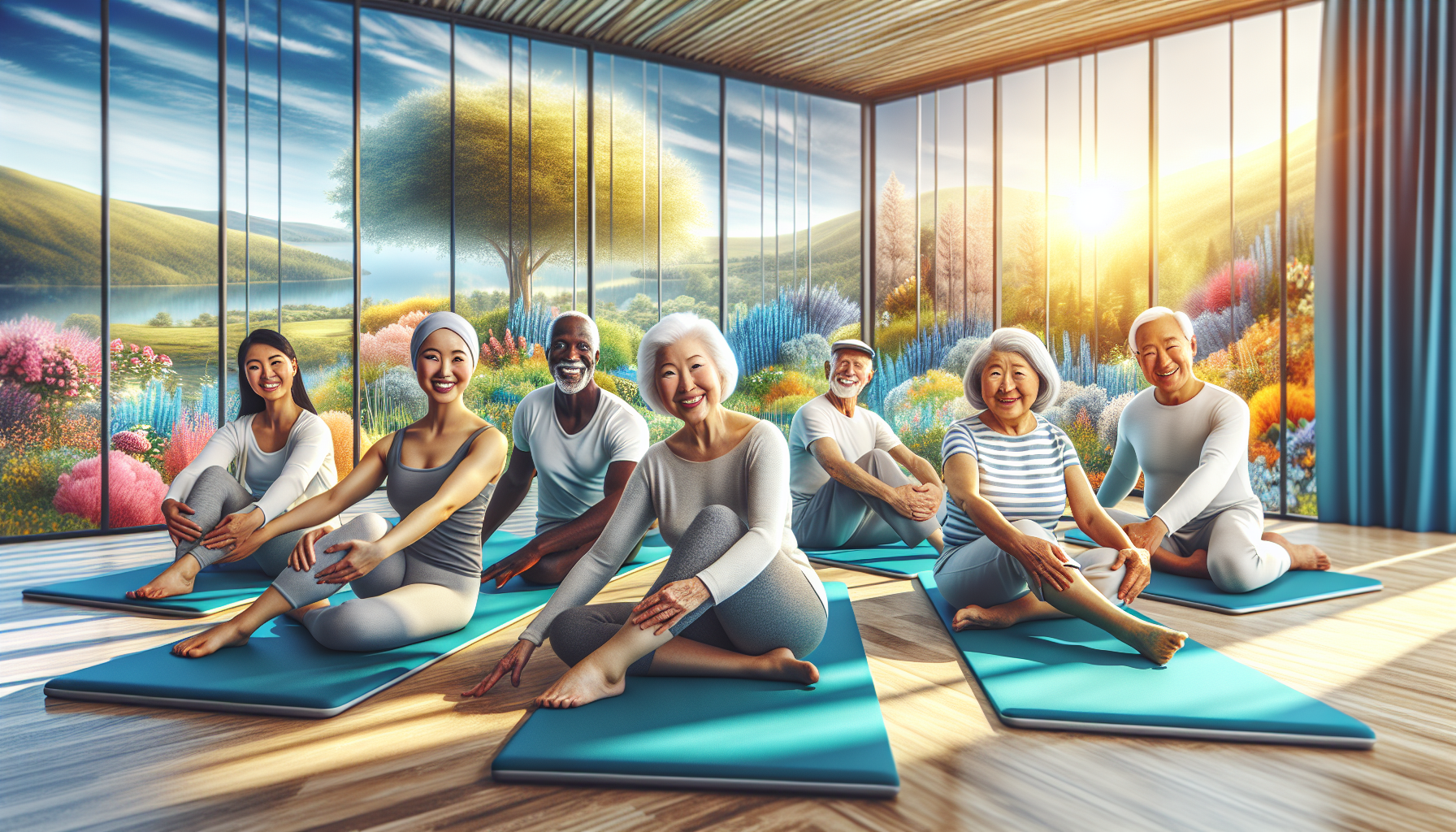
A diverse group of smiling seniors practicing pilates on mats in a sunny and spacious room with a view of nature.

Pilates is one of the most appropriate exercise methods for older adults: it builds strength without high-impact joint loading, trains the deep core muscles that protect the spine, improves balance through controlled movement, and addresses the postural changes (forward head, rounded shoulders, reduced lumbar curve) that commonly develop with age.

Consult your doctor or physical therapist before starting if you have osteoporosis, recent fractures, severe arthritis, or significant balance concerns.

Why Pilates Suits Older Adults Specifically

As we age, two things happen simultaneously that compound each other: muscle mass decreases (sarcopenia) and deep stabilizing muscles — particularly the transverse abdominis and multifidus — lose activation efficiency. This combination reduces balance, increases fall risk, and is a primary driver of chronic lower back pain in older adults. Pilates directly targets both problems. Unlike general strength training, which prioritizes the larger surface muscles, Pilates emphasizes the deep stabilizing system that supports the spine and pelvis during movement.

What You Need

A mat or firm carpeted surface. A chair within reach for balance support during standing exercises. Optional: a resistance band and a small firm pillow. No other equipment is necessary.

The Beginner Program — 3 Days Per Week

Complete this program 3 times per week for the first 6 to 8 weeks before progressing. Rest at least one day between sessions.

Foundation Exercises (Perform 2 Rounds Each)

Pelvic tilt — 10 reps
Lie on your back, knees bent, feet flat. Exhale and gently press your lower back into the mat. Inhale and release to neutral. This small movement activates the deep abdominals and teaches the neutral spine position that all other Pilates exercises depend on.

Heel slide — 10 reps per side
Same starting position. Exhale and slowly slide one heel along the floor, straightening that leg, while keeping the lower back from arching. Return and switch. Directly trains the transverse abdominis through limb movement — the key challenge in Pilates.

Glute bridge — 12 reps
Feet flat, press through heels to lift hips to a diagonal line. Hold 3 seconds, lower slowly. Strengthens glutes and hamstrings, which are critical for rising from chairs and climbing stairs. Progress to single-leg version after 4 weeks.

Bird dog — 8 reps per side
On all fours. Extend right arm forward and left leg back simultaneously. Hold 3 seconds, return. Keep hips level — no rotation. This exercise is backed by physical therapy research for lower back rehabilitation and multifidus activation.

Chair-assisted standing balance — 30 seconds per side
Stand behind a chair, hands resting lightly on the back. Lift one foot off the floor slightly. Hold without gripping the chair if possible. Progress by using just one finger on the chair, then no contact.

Seated spine twist — 10 reps per side
Sit tall in a chair. Arms crossed over chest. Rotate your upper body to the right as far as comfortable, return to center, rotate left. Keep hips facing forward. Maintains spinal rotation mobility that reduces stiffness.

Intermediate Additions (After Weeks 6 to 8)

Dead bug — 8 reps per side
On your back, arms toward ceiling, knees at 90 degrees above hips. Lower back pressed into mat. Extend right arm overhead and left leg simultaneously. Return and switch. The back must stay pressed flat — this is the difficulty.

Side-lying leg lift — 12 reps per side
Lie on your side, body in a straight line. Lift the top leg to about 45 degrees, lower with control. Targets outer glutes (gluteus medius), which are critical for hip stability and lateral balance when walking.

Swan prep — 8 reps
Lie face down, hands under shoulders. Press your chest up slightly — elbows remain bent. Hold 2 seconds, lower. Counteracts the forward-rounding posture common in older adults.

Important Modifications

  • If getting down to the floor is difficult: most of these exercises can be adapted to a bed (firm mattress) or performed seated in a chair.
  • If neck strain occurs during any curl-up exercise: keep your head on the mat and focus only on the lower body and core movements.
  • If wrist pain occurs during bird dog: perform on fists rather than open hands, or substitute a forearm-supported version.

Progress Markers

After 8 weeks of consistent practice, most people notice: easier time rising from chairs, improved posture awareness during daily activities, reduced lower back stiffness, and better single-leg balance. These functional improvements are the goal — they indicate the deep core system is being effectively retrained.

Joint-Friendly Strength Training for Seniors: 10 Exercises That Build Strength Safely

A diverse group of smiling seniors doing gentle water aerobics together in a sunny pool.

Strength training is one of the most important things older adults can do — it slows muscle loss (sarcopenia), maintains bone density, improves balance, and supports the functional capacity needed for independent living. The challenge is choosing exercises that load the muscles effectively without stressing aging joints.

If you have diagnosed joint conditions, recent surgery, or significant pain during exercise, work with a physical therapist before starting independently. This guide is appropriate for people with normal age-related joint sensitivity, not acute injury or advanced joint disease.

Joint-Friendly Training Principles

Avoid impact: No jumping, no heavy landing. Impact multiplies joint load — a light jog creates 3 to 4 times bodyweight of force through the knees with each stride. Strength training doesn’t require impact.

Control the range of motion: Train through the range that doesn’t produce pain. A half-depth squat that’s pain-free is more beneficial than a full-depth squat done through discomfort.

Slow the lowering phase: Slow eccentrics (3 to 4 seconds lowering) build strength with less joint stress than explosive movements, because the force is distributed over time.

Prioritize muscle activation, not load: Light weight with complete muscle engagement produces better results for seniors than heavy weight with compensated form.

The 10 Exercises

1. Sit-to-Stand (Chair Squat)

Sit at the edge of a chair, feet hip-width, arms crossed over chest. Rise using leg strength only — no pushing off the armrests. Lower slowly (3 to 4 seconds). This is the most functional exercise in the list: it directly trains the movement required for independent daily living.
3 sets of 10 to 12 reps. Progress by holding light weights at your chest.

2. Wall Push-Up

Stand an arm’s length from a wall, hands shoulder-width. Lower chest toward wall, press back. Gentle on shoulder and wrist joints while still building meaningful chest and tricep strength for pushing motions.
3 sets of 15 reps. Progress to incline push-up (hands on counter), then floor push-up.

3. Step-Up

Use a bottom stair, sturdy step, or a low platform. Step up with one foot, press through that heel to bring the other foot up. Step down with control. Develops single-leg strength without knee impact.
3 sets of 10 per side. Hold a wall for balance if needed.

4. Seated Resistance Band Row

Sit in a chair. Loop a resistance band around a fixed point at about chest height, or hold both ends of a band around your feet. Pull your elbows back, squeezing shoulder blades together. Release slowly.
3 sets of 12 reps. Essential for countering the forward-rounding posture common with age.

5. Glute Bridge

Lie on your back, knees bent, feet flat. Press through heels to lift hips. Hold 2 seconds at the top, lower slowly. Protects the knees and hips while directly building the glutes — the primary muscle for standing from seated, climbing stairs, and maintaining upright posture.
3 sets of 15 reps.

6. Standing Hip Extension

Hold a chair back for support. Stand on one leg. Extend the other leg straight back — not lifting too high, just a foot off the floor. Return with control. Targets glutes and hip extensors without knee loading.
3 sets of 12 per side.

7. Seated Leg Extension

Sit in a chair, sit tall. Slowly straighten one leg fully, hold 2 seconds at the top, lower slowly. Strengthens the quadriceps through a controlled range without knee joint compression.
3 sets of 12 per side. Add an ankle weight when 15 reps feel manageable.

8. Wall Sit

Slide down a wall until thighs are as parallel to the floor as comfortable (stop before pain). Hold. This isometric exercise builds quad strength with zero joint movement — no compression cycle, no impact.
3 holds of 20 to 40 seconds.

9. Resistance Band Overhead Press

Stand on a resistance band, hold both ends. Press overhead until arms are straight. Lower with control. Builds shoulder strength needed for reaching overhead in daily activities — a functional movement seniors often avoid due to weakness.
3 sets of 10 reps. Sit in a chair if standing balance is a concern.

10. Calf Raise

Stand near a wall for balance support. Rise onto the balls of your feet slowly, lower slowly. Calf strength is directly linked to ankle stability and walking balance.
3 sets of 15 to 20 reps. Progress to single-leg calf raise.

Building a Weekly Schedule

Train the full circuit 2 to 3 times per week with at least one rest day between. Most seniors starting strength training notice meaningful improvements in 6 to 8 weeks: easier time rising from chairs, fewer stairs that feel difficult, and reduced fatigue during daily activities. These are the early functional markers that indicate the program is working.